
Sash Jammers for PVCu Doors & Windows: The Ultimate Security Upgrade Guide
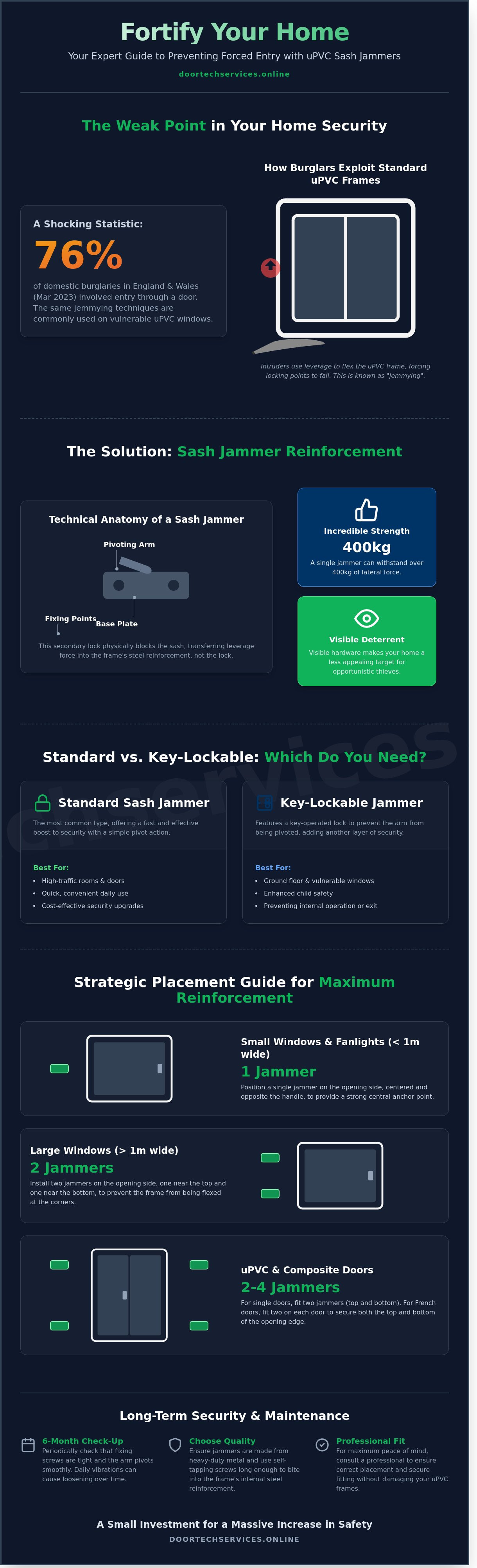
Did you know that 76% of domestic burglaries in England and Wales for the year ending March 2023 involved an intruder entering through a door? Most standard locking mechanisms fail quickly against a determined jemmy or the common lock snapping technique used by modern burglars. Installing sash jammers for PVCu windows and doors is one of the fastest, most cost-effective ways to stop these attacks in their tracks. These heavy-duty components act as a secondary physical barrier, ensuring your home remains a fortress even if the primary lock is bypassed.
You likely feel vulnerable to these sophisticated entry methods and worry that your current security isn't enough. It's common to feel overwhelmed by the technical details or fear that a DIY installation might permanently ruin your expensive PVCu frames. This expert guide removes that stress. Discover how to effectively use sash jammers to fortify your property against forced entry with our transparent, step-by-step instructions. We'll show you exactly how many jammers to buy for every window type and give you the confidence to achieve a seamless, professional fit that guarantees long-term value and safety.
Key Takeaways
Secure your home against forced entry by understanding how secondary locking devices prevent intruders from jemmying your door & window frames.
Identify whether standard or key-lockable sash jammers for PVCu doors & windows provide the best balance of convenience and heavy-duty security for your property.
Follow our expert placement guide to correctly position hardware on different frame sizes for maximum structural reinforcement.
Implement a simple six-month maintenance routine to ensure your security hardware remains precision-calibrated and effective against daily vibrations.
Table of Contents
Enhancing Home Security with Sash Jammers for PVCu Doors & Windows
Securing your home starts with identifying the weakest entry points. For many UK households, the standard locking system on plastic frames provides a false sense of total safety. A sash jammer is a robust, secondary security device specifically engineered for PVCu door & window frames. It consists of a weighted metal arm that pivots over the window sash, physically blocking it from moving even if the primary lock is compromised. These devices offer a massive security boost for a minimal investment, making them a top choice for cost-effective home protection.
Professional locksmiths recommend a layered security approach. You shouldn't rely on a single mechanism to keep intruders out. Instead, integrate these jammers with your existing door & window hardware to create multiple points of resistance. When a burglar encounters sash jammers for PVCu doors & windows, they face a physical barrier that requires significantly more time and noise to bypass. This delay is often enough to make a criminal abandon the attempt entirely. Your safety is our priority, and adding these mechanical stops is a proactive step toward a more secure property.
The Vulnerability of Standard PVCu Locking Points
Standard PVCu frames are inherently flexible. While modern multi-point locks are strong, the plastic material can be manipulated. Intruders often use a "jemmying" technique, where a crowbar or large screwdriver is inserted between the sash and the frame. By applying leverage, they can force the locking bolts out of their keeps. According to crime data from 2023, forced entry remains a primary method for residential burglaries in England and Wales. A single lock, regardless of its quality, may fail if the frame itself is flexed away from the mechanism. Sash jammers provide a vital anchor point that resists this specific type of lateral force.
How Sash Jammers Act as a Visible Deterrent
Visual cues play a massive role in home defence. Most opportunistic burglars scan a street for the easiest target. Seeing high-visibility security hardware installed on the interior of a frame sends a clear message: this home is prepared. It removes the "quick win" factor that criminals crave. Beyond the physical strength they add, these devices provide immediate peace of mind for homeowners and are often viewed favourably during home insurance assessments.
Technical Anatomy and How Sash Jammers Prevent Forced Entry
A sash jammer is a mechanical secondary security device designed to reinforce the weakest points of your glazing. The device consists of three primary components: a heavy-duty base plate, a pivoting arm, and a series of spacers. The base plate serves as the foundation, secured directly into the PVCu frame or sash using self-tapping screws that should ideally bite into the internal steel reinforcement. The pivoting arm is the moving component that swings over the opening sash or frame to prevent it from being pushed or pulled open.
The physics of the jamming action is straightforward but incredibly effective. Most burglars use a crowbar or large screwdriver to lever the door or window sash away from the frame, bypass the internal locking points, and gain entry. Sash jammers for PVCu doors & windows create a physical "stop" that transfers this leverage force away from the delicate internal gearbox and lock points into the structural frame itself. A single well-fitted jammer can often withstand over 400kg of lateral force, making it nearly impossible to force the door or window without shattering the glass or causing significant noise.
Precision in the "stop" position is vital for security. The arm must sit perfectly perpendicular to the frame when engaged. If the arm is too short, it won't provide enough overlap on the sash to resist a heavy blow. Most professional-grade jammers feature an arm length of approximately 55mm to 60mm, ensuring a secure grip on the profile. Finally, plastic cover caps are used to snap over the screw heads. These aren't just for aesthetics; they protect the fixings from moisture and prevent intruders from easily identifying how the device is attached. For homeowners concerned about existing lock vulnerabilities, a quick consultation with a us can identify the best placement for these devices.
Material Matters: Zinc Cast Alloy vs. Aluminium
Don't settle for cheap components when your home security is at stake. Many budget jammers use lightweight aluminium which can snap under the pressure of a sustained attack. High-security sash jammers for PVCu doors & windows are manufactured from zinc cast alloy. This material offers superior tensile strength and durability. High-quality finishes, such as salt-spray tested powder coating, ensure the metal resists corrosion for 10+ years, even in coastal environments. Always look for jammers with a solid core rather than hollowed-out versions to ensure maximum resistance.
The Role of Spacers and Packers
PVCu door & window profiles are not universal. Different manufacturers use varying frame thicknesses, often resulting in an upstand height between 15mm and 21mm. If the jammer arm sits too high, a gap remains that allows the sash to move. If it sits too low, it will scrape and damage the PVCu or foiled finish. 1mm and 2mm spacers allow you to customise the height of the base plate for a flush fit. A spacer is a precision tool for alignment that ensures the arm glides smoothly while maintaining a tight seal against the sash.
1mm Spacers: Ideal for fine-tuning the clearance on modern, slimline profiles.
2mm Packers: Used for older, thicker PVCu frames to prevent the arm from catching.
Stackable Design: Most spacers can be stacked to reach the exact millimetre required for your specific window.
Standard vs. Key-Lockable Sash Jammers: Which Do You Need?
Choosing the right hardware defines your home's defensive perimeter. Standard sash jammers offer a quick manual turn to secure the frame. They work perfectly for windows you open and close daily. You simply flip the arm to lock or release the sash. It is a fast, effective solution for adding a secondary layer of protection without the hassle of managing keys. Key-lockable versions add a mechanical deadbolt to that arm. This prevents anyone from moving the jammer even if they manage to break a small hole in the glass or manipulate the handle from outside.
Your safety is our priority. While both types provide a physical barrier, the locking mechanism turns a simple deterrent into a robust security feature. If a burglar attempts to force the window, the locked arm stays rigid. It cannot be vibrated or shaken into the open position. This extra step provides immediate peace of mind for vulnerable entry points.
When to Choose Key-Lockable Versions
Install key-lockable sash jammers for PVCu doors & windows on all ground floor entry points and accessible patio doors. These are high-risk areas where burglars often attempt "fishing" through letterboxes or small gaps to manipulate internal handles. A locked jammer resists forced rotation from the outside. Most manufacturers provide a universal key for all units in your home. This simplifies your security routine. You won't struggle with a heavy bunch of different keys. For upper-floor rooms, these locks serve a dual purpose. They act as a vital safety restrictor. A locked arm prevents the window from opening wide enough for a child to fall through, providing a necessary safeguard for families.
Assessing Your Window Type: Sash, Tilt & Turn, or Door?
The direction your window opens dictates where you mount the device. For standard outward-opening windows, fit the jammer to the opening sash. For inward-opening tilt and turn styles, you must mount the jammer on the frame. PVCu French doors benefit significantly from these upgrades. We recommend fitting two sash jammers per door leaf. Place one 150mm from the top and another 150mm from the bottom. This prevents the door from being pried away from the frame at the corners.
Check your frame material before installation. Ensure you have at least 20mm of flat frame surface for a secure mount. You need a solid connection to the internal steel reinforcement of the PVCu profile. This ensures the device holds firm under pressure. Don't settle for a weak fixing. A secure installation is the only way to guarantee long-term value and protection.
Strategic Placement: Where and How Many Jammers Should You Install?
Security is a game of leverage. To stop an intruder, you must reinforce the weakest points of your frame where prying is most effective. A single lock is rarely enough to withstand a determined forced entry attempt. Proper placement of sash jammers ensures the force of an attack is distributed across the strongest parts of the profile.
Small windows (under 600mm): Install one jammer. Position it centrally on the opening side to provide a single, solid pivot point.
Large windows: Use two jammers. Fit them 100mm to 150mm from the corners on the handle side. This prevents the sash from being flexed or bowed outwards at the edges.
Single doors: Install two jammers on the handle side. This reinforces the existing multi-point locking system against heavy-duty prying tools.
French or Patio doors: These units require four jammers in total. Fit two per leaf top & bottom to provide maximum resistance and ensure the doors cannot be forced apart at the meeting stiles.
Optimal Positioning for Maximum Resistance
Positioning determines whether a jammer holds firm or fails under pressure. Don't place the device too close to the existing handle mechanism. Internal gearboxes take up significant space inside the PVCu profile; drilling into them will break your lock. Ensure the jammer arm has at least 20mm of "bite" or overlap on the frame. This overlap is what provides the physical barrier. Always perform a clearance check. The arm must rotate freely without hitting the window handle when the window is in use.
Step-by-Step Installation and Fixing Requirements
Precision is vital for a secure fit. You'll need a power drill, a 2mm or 3mm pilot bit, and a manual screwdriver. Start by marking the hole positions with a pencil. Drill your pilot holes to a depth of 25mm. This depth is sufficient to grip the PVCu without penetrating too far into the hollow chambers. Use the self-tapping screws provided in the kit. These are engineered to cut their own thread into the plastic for a tight, vibration-resistant fit.
Accuracy saves your glass. Most modern double-glazed units sit 15mm to 20mm from the edge of the frame. Keep your drill bit straight to avoid hitting the edge of the glass unit. If you feel the drill hit metal, you've reached the internal steel reinforcement. Don't panic. Switch to a high-quality HSS bit to finish the hole. Fixing directly into the steel reinforcement provides the highest level of security possible. If you need help securing your home, book a professional security survey today.
Maintaining Your Window Security and Choosing Quality Hardware
Security hardware is not a fit and forget solution. It requires a consistent maintenance schedule to ensure your home remains a fortress. PVCu frames naturally vibrate during daily operation; they also flex during the high-speed winds common across the UK. These micro-movements can loosen fixings over time. Check the tightness of every mounting screw every six months. A loose screw reduces the leverage resistance of the device, which gives an intruder a mechanical advantage they don't deserve.
Apply a single drop of light machine oil or a silicone-based lubricant to the pivot point twice a year. This prevents the metal components from grinding and ensures the arm swings smoothly when you need to lock up for the night. Our goal is functional restoration and long-term durability. We want your hardware to work perfectly every single time you touch it. Technical precision matters when your safety is on the line.
Routine Maintenance: Keeping Hardware Functional
Keep the external finish looking professional by wiping it down with a soft, damp cloth. Never use abrasive chemical cleaners or steel wool on the zinc coating. These harsh materials strip away the protective layer and leave the metal vulnerable to oxidation. If your hardware includes a locking cylinder, inspect the keyway for trapped grit or household dust. A quick blast of compressed air keeps the internal pins moving freely. A well-maintained jammer can last the life of the window, saving you the cost of future repairs and replacements.
Why Quality Parts Ensure Long-Term Protection
The market is flooded with unbranded hardware made from brittle, low-grade alloys. These budget options often snap under the pressure of a crowbar because the casting is porous and weak. Door-Tech Services stocks high-specification sash jammers that are built for the heavy-duty demands of UK home security. We select parts based on their technical precision and ability to resist corrosion in damp climates. Our hardware is tested to withstand 50,000 cycles without failure.
Choosing professional-grade equipment is a direct investment in your safety. We provide the tools and the expertise to secure your property properly the first time. Don't settle for inferior imitations that fail when they are tested by a real-world break-in attempt. Browse our full security range today to upgrade your home with certified, reliable hardware. Your safety is our priority; we are ready to help you secure your windows with components you can trust.
Fortify Your Property with Professional Grade Hardware
Don't leave your property's safety to chance when a simple mechanical upgrade can deter most opportunistic intruders. Installing **sash jammers **provides a robust physical barrier that prevents frames from being forced open. These components are manufactured from expert-selected zinc cast alloy to ensure they don't snap under pressure. Since 2007, Door-Tech Services has operated as a dependable safeguard for UK homeowners, focusing on hardware that offers long-term durability. By placing jammers strategically on your door & window frames, you create a reinforced seal that is incredibly difficult to bypass.
We provide national UK delivery on all security components, ensuring you have the tools to protect your home without delay. Every jammer in our range meets strict quality standards to provide the precision and reliability you expect from a local expert. It's time to turn your windows into a formidable line of defence. Secure your home today with our range of high-quality Sash Jammers. You'll feel much better knowing your house is properly protected tonight.
Frequently Asked Questions
Do sash jammers damage PVCu windows during installation?
Sash jammers won't damage your PVCu frames if you follow correct installation procedures. You must drill small pilot holes into the internal steel reinforcement to ensure a secure fit. This process maintains the structural integrity of the frame while adding a heavy-duty layer of protection. Incorrect drilling can cause cosmetic marks, but following 2024 industry guidelines prevents any functional issues.
How many sash jammers do I need per window for maximum security?
You should install two sash jammers for PVCu windows on large opening panes to provide maximum resistance against forced entry. For smaller windows under 600mm in width, a single jammer placed centrally is often sufficient. Placing one at the top and one at the bottom of larger frames distributes the pressure evenly. This setup creates a reinforced barrier that withstands significantly more force than a standard locking mechanism.
Can I use sash jammers on my front door as well as windows?
You can fit sash jammers to PVCu doors to provide an extra level of security against door snapping or prying. We recommend installing two units on a standard door, placed roughly 200mm from the top and bottom corners. These devices act as a secondary deadbolt. They're particularly effective on back doors or patio doors where burglars often attempt to force the frame.
Will fitting sash jammers invalidate my window warranty?
Fitting sash jammers might invalidate your manufacturer warranty if the terms strictly prohibit drilling into the profile. Most UK window warranties last for 10 years, so check your specific documentation before starting work. Many homeowners prioritise the 25 percent reduction in burglary risk reported in security surveys over the warranty coverage. If your windows are older than 10 years, the warranty has likely expired anyway.
What is the difference between a sash jammer and a window restrictor?
A sash jammer is a security device designed to stop a window from being forced open, while a window restrictor limits how far a window can open for safety. Restrictors typically allow a 100mm gap for ventilation while preventing accidental falls. Sash jammers are heavy-duty blocks that keep the window sealed shut against intruders. They serve different purposes but work well together to protect your home.
Are sash jammers easy to install as a DIY project?
You can install sash jammers as a DIY project in about 15 minutes per window using a drill and a screwdriver. You'll need a 3mm drill bit to create pilot holes in the PVCu and internal steel reinforcement. It's a straightforward task for anyone comfortable with basic home maintenance. If you're unsure about drilling, we can handle the installation to ensure the alignment is precise.
Can sash jammers be opened from the outside by a burglar?
Burglars cannot open sash jammers from the outside because the device is fixed to the internal frame or sash. Even if an intruder breaks the glass or bypasses the main lock, the jammer arm stays firmly in place. This physical barrier prevents the sash from moving. According to UK police security advice, adding visible internal locks like these acts as a powerful deterrent to opportunistic thieves.
Do I need a key to operate a sash jammer every time?
You don't need a key to operate standard sash jammers; you simply turn the arm by hand. Some models come with a locking button or a key for extra security, which is useful if you have children or want to prevent "fishing" through a letterbox. Standard non-locking versions offer the fastest operation during an emergency. Choose the keyed version if you need to lock the arm in the closed position.



Comments