
Choosing the Best Euro Cylinder Locks: A 2026 Security Buyer’s Guide
Updated: Apr 19
Your front door is likely the weakest link in your home security, as a thief can snap a standard lock in less than 13 seconds using basic tools. This vulnerability accounts for roughly 25% of forced entries in UK residential burglaries according to recent crime statistics. You shouldn't have to lie awake wondering if your family is safe. Choosing the right euro cylinder locks is the most effective way to harden your home against these common attacks.
It's frustrating to face a wall of confusing 1-star and 3-star ratings while worrying about ordering the wrong size. You want a secure home and the satisfaction of fitting the hardware yourself to save on call-out fees that often exceed £100. This guide provides the technical clarity you need to master security ratings and measurements with total confidence. We will break down the latest 2026 Kitemark standards and show you how to measure your door with millimetre precision for a guaranteed fit.
Key Takeaways
Identify the crucial differences between 1-star and 3-star TS007 ratings to ensure your home meets the latest British security standards.
Master the "centre-measurement" rule to guarantee a precise fit and eliminate the vulnerabilities caused by an incorrectly sized lock.
Learn how to select high-security euro cylinder locks featuring anti-snap technology to neutralise the most common forced entry methods.
Compare the practical benefits of thumb turn cylinders and keyed-alike systems to balance fire safety with effortless access across your property.
Follow our professional guide to remove your old hardware in under 60 seconds and upgrade to 2026’s top-rated brands like APECS and Ultion.
Table of Contents
Understanding Euro Cylinder Locks and Modern Home Security
Euro cylinder locks are the primary security standard for homes across the United Kingdom. They provide the vital link between your key and the door's internal locking hardware. Most PVCu and composite doors manufactured since the mid-1990s rely on this specific design. Your safety depends on the integrity of this single component. It's a compact unit, but it controls the massive steel bolts that keep your property secure.
The internal mechanics rely on a pin tumbler lock system. When you insert the correct key, the pins align perfectly to allow the plug to rotate. This rotation turns the central cam. The cam acts as a lever, engaging the multipoint locking system to throw hooks and deadbolts into the door frame. It is a system of mechanical precision. If the cylinder fails, the entire door becomes a liability. We see these failures daily and understand the urgency of a fix. Your safety is our priority, and we ensure every installation meets 2026 insurance requirements.
The "Lock Snapping" epidemic remains a critical threat to UK households. Burglars have identified that older, basic cylinders are vulnerable to physical force. An intruder can snap a budget lock in under 10 seconds using simple hand tools. Data from UK police forces in early 2026 suggests that lock snapping still accounts for roughly 27% of all forced residential entries. Upgrading to a modern, anti-snap cylinder is the most cost-effective security improvement available today. It is a small price to pay for immediate peace of mind. We provide certified hardware that stops these attacks instantly.
The Anatomy of a Euro Cylinder
Each cylinder contains a plug, a series of pins, and heavy-duty springs. The fixing hole is located centrally to secure the lock within the door. When the key turns, the central cam rotates to move the door's locking bolts. High-security 2026 models feature sacrificial snap lines. These lines ensure that if a burglar applies force, the lock breaks at a predetermined point, leaving the internal mechanism intact and the door locked. Precision engineering keeps the intruder out while allowing you to still use your key from the inside.
Common Applications for Euro Cylinders
Residential Doors: Standard equipment for 95% of UK PVCu and composite front and back doors.
Commercial Shopfronts: Found in aluminium doors and heavy-duty retail entrances requiring high-frequency use.
Internal Security: Used for office doors or storage rooms where restricted access is mandatory.
We arrive on time to secure your property. Our technicians use only certified, heavy-duty hardware to guarantee long-term value. Don't leave your home's safety to an outdated cylinder. Upgrade today for a seamless security experience.
Decoding Security Ratings: 1-Star vs 3-Star Euro Cylinders
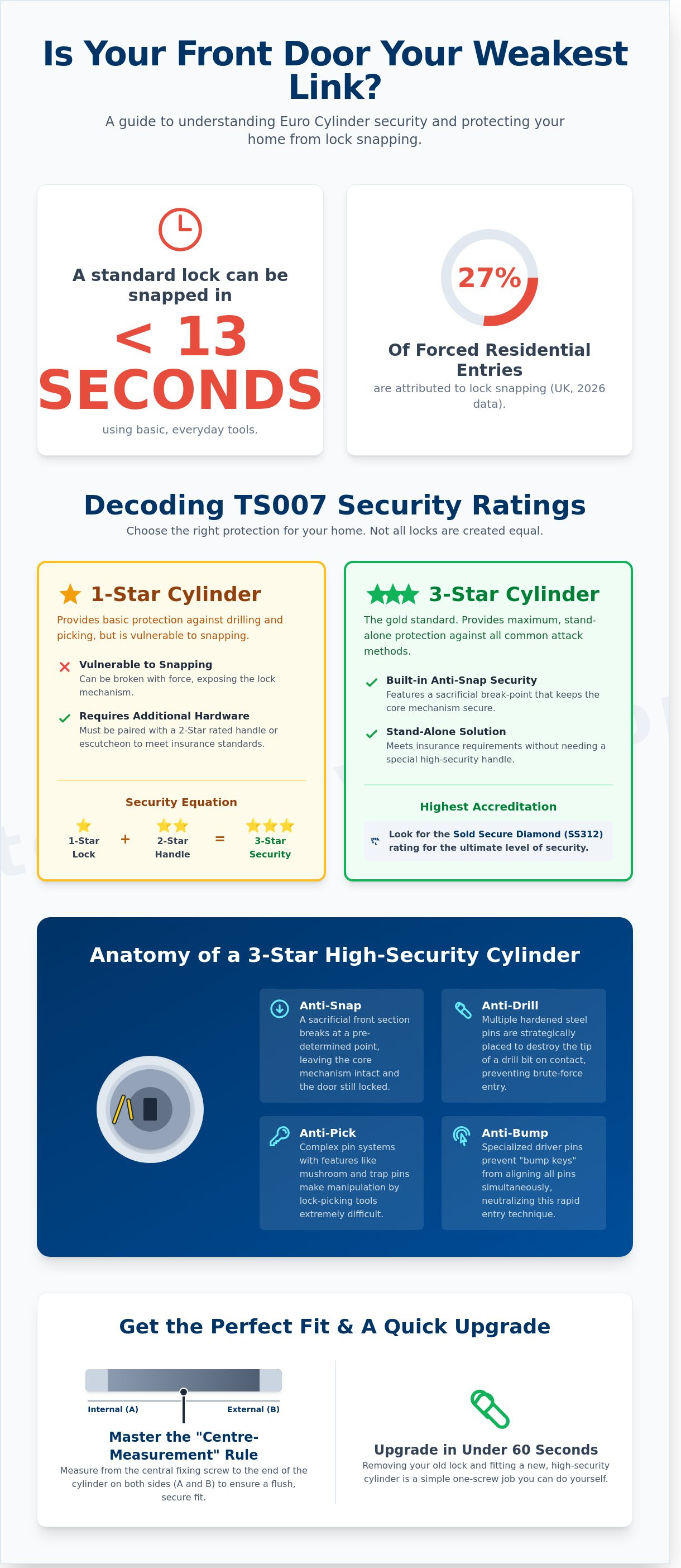
Understanding the TS007 British Standard is the first step toward securing your home. This rating system uses a star-based hierarchy to grade the physical strength of euro cylinder locks. In 2024, statistics showed that roughly 65% of forced entries involved lock snapping. This is why the star rating matters. A 1-star cylinder provides basic internal protection but lacks the structural integrity to resist snapping on its own. To achieve a secure setup with 1-star hardware, you must pair it with a 2-star high-security handle. This combination creates the necessary 3-star protection required for modern safety.
A 3-star cylinder is the Gold standard for stand-alone security. It's engineered to withstand a direct snapping attack without any additional hardware. Many homeowners prefer this option because it allows them to keep their existing handles while significantly upgrading their protection. For the highest level of assurance, look for the Sold Secure Diamond rating. This independent test is often more rigorous than the standard Kitemark. According to this Master Locksmiths Association guide, the SS312 Diamond rating represents the pinnacle of cylinder security. It ensures the lock has been tested against the most aggressive manual attack methods used by criminals today.
Anti-Snap, Anti-Pick, and Anti-Drill Features
Modern euro cylinder locks use sacrificial snap lines to defeat burglars. If a thief applies force, the lock snaps at a predetermined point. This leaves the vital internal mechanism intact and the door remains locked. It's a simple, effective solution that stops an attack in seconds. We also look for hardened steel pins within the cylinder core. These pins destroy drill bits on contact, preventing attackers from drilling out the plug. Anti-bump technology is equally vital. It uses specialized driver pins to stop "bump keys" from vibrating the lock open. These technical precision features ensure your door remains a solid barrier.
Insurance Requirements and Compliance
Don't wait for a break-in to check your insurance small print. Many UK providers now mandate a minimum 3-star security level for all external doors. If your locks don't meet the TS007:2014+A1:2015 standard, your policy might be void. You can identify your current security level by looking for the Kitemark symbol and the star rating engraved on the side of the lock. It's usually visible near the keyhole. If you can't see a star rating, your lock is likely outdated. We offer expert security checks to help you identify vulnerable entry points. Always verify the certification of a new lock before purchase to ensure it meets the latest 2026 safety benchmarks.
How to Measure Your Euro Cylinder Lock for a Perfect Fit
Precision is the difference between a secure home and a vulnerable one. When measuring euro cylinder locks, never calculate the total end-to-end length. This common mistake leads to incorrect cam alignment and mechanical failure. Instead, always measure from the centre of the fixing screw hole to the edges. This ensures the internal mechanism functions without friction or jamming. Accuracy saves lives.
Open your door to access the side profile. Locate the large retaining screw that sits directly beneath the latch. Measure from the centre of this screw to the internal edge of the door handle (Dimension A). Repeat the process for the external side (Dimension B). Record these figures in millimetres. If your internal measurement is 35mm and the external is 45mm, you require a 35/45 cylinder. Don't guess these numbers. A 5mm error can compromise your entire door security.
Security depends on orientation. Anti-snap features are designed to sacrifice the front portion of the lock during an attack, keeping the internal core intact. This protection must face the outside. We recommend following West Yorkshire Police guidance on lock security to verify your hardware meets the TS 007 3-star rating. Installing a lock backwards renders these safety features useless. Always look for the 'EXT' mark on the cylinder body to ensure the anti-snap side faces the street side.
Common Euro Cylinder Sizes in the UK
Standard PVCu doors often use offset sizes 35/55 (90mm) or 50/50 (100mm) sizes. Modern composite doors are thinner and frequently require symmetrical cylinders, such as a 35/35 or 40/40. Check your measurements twice. Your lock must not protrude more than 3mm from the handle face. A lock that sticks out further is a prime target for 'lock snapping' tools. If your cylinder is too long, replace it immediately.
Tools Needed for Measurement and Replacement
You don't need a professional toolkit for this task. Gather these three items to get the job done right:
Phillips head screwdriver: Use this to remove the single retaining screw located on the door edge.
Existing key: You must rotate the cam 20 degrees to align it with the lock body, allowing the cylinder to slide out.
Steel ruler: A tape measure can flex, but a steel ruler provides the millimetre accuracy needed for a 100% perfect fit.
If the lock doesn't slide out easily, don't force it. Wiggle the key slightly while applying gentle pressure. Once the cylinder is out, you can measure it on a flat surface for absolute certainty. This simple process takes less than five minutes but guarantees your home remains a fortress.
Comparing Keyed Alike, Thumb Turn, and Anti-Snap Features
Security isn't one-size-fits-all. You need to balance easy exits with hard entries. Most euro cylinder locks installed in 2024 now feature modular designs. This lets you customise the mechanical function of every door in your home while maintaining a high security standard. Choosing the right configuration depends on the specific door location and who lives in the property.
For external structures like garage doors or garden gates, a half cylinder is the standard choice. These locks typically measure 30/10mm or 35/10mm. They only feature a keyhole on the external side. This design prevents anyone from tampering with the lock from the inside of a shed or garage. It’s a cost-effective way to secure outbuildings without paying for internal locking components you don't need.
If you want to stop unauthorised key duplication, look for restricted key profiles. These locks come with a unique security card. High-street key cutters cannot replicate these keys without seeing that card. This provides 100% control over who has access to your property. It’s a vital feature if you frequently give keys to tradespeople or cleaners.
The Pros and Cons of Thumb Turn Locks
Thumb turn cylinders replace the internal keyhole with a simple twist knob. This allows for a fast exit during a fire or emergency. UK Building Regulations Part B often requires these in flats and apartments to ensure residents don't need to find a key to escape. They're also excellent for elderly residents who may struggle with small keys in high-stress situations.
However, they have a specific vulnerability. If your door has large glass panels or a letterbox within 60cm of the lock, an intruder could reach through and turn the knob. We recommend installing a letterbox restrictor or using security-laminated glass to mitigate this risk. Always prioritise safety without compromising your perimeter.
Organising Your Home Security with Keyed Alike
Keyed alike systems allow you to operate your front, back, and patio doors with a single key. This reduces a bulky 200g bunch of keys to a single 15g unit. Our technicians order multiple cylinders with matching internal pins to ensure seamless operation across your entire house. It simplifies your daily routine and reduces wear on your pockets.
Bulk reduction: Carry one key instead of five.
Precision matching: Every lock is calibrated to the same security code.
Maintenance: If you lose one key, you must replace all cylinders in the set to maintain security.
Don't settle for a basic setup when you can have a custom security solution. If you need help choosing the right configuration for your home, contact us for a free estimate today.
Upgrading Your Security: Selecting and Fitting Your New Lock
Securing your home shouldn't be a day-long project. For 2026, we recommend two standout brands that define modern home protection: APECS and Ultion. The APECS AP series and Ultion WXM series offer superior resistance against the latest lock-snapping techniques. These euro cylinder locks are engineered for precision, ensuring your door stays shut when it matters most. Your safety is our priority, and choosing a brand with a 3-star TS007 rating is the first step toward a secure home.
Removing your old cylinder is a task you can complete in under 60 seconds. Open the door and locate the large fixing screw on the side of the door leaf, usually found just below the latch. Unscrew it completely. Insert your key, turn it roughly 25 degrees to align the internal cam with the lock body, and pull the unit toward you. It’s that simple. To install the new lock, reverse the process. Slide the new cylinder in, ensure the cam is aligned so it passes through the gearbox, and hand-tighten the fixing screw. Don't force it; the screw should glide in easily if the lock is positioned correctly.
Testing is the most critical step of the installation. Always check the lock's operation with the door wide open first. Turn the key to ensure the deadbolt extends and retracts without any mechanical resistance. Once you're confident, test it with the door closed. This ensures the strike plate is perfectly aligned with your new hardware and that the door seals correctly against the frame.
Troubleshooting Common Installation Issues
If the cam won't rotate into position, wiggle the key slightly while applying gentle pressure. This usually clears any internal misalignment within the gearbox. If the lock feels stiff, never reach for standard oil or WD-40. These products attract dust and grit, which will eventually seize the high-security pin tumblers. If the fixing screw feels stuck, back it out and restart. Cross-threading the screw can permanently damage the lock's internal threads, leading to a failed installation and a compromised door.
Maintaining Your Euro Cylinder for Longevity
To keep your lock functioning like new, use a dedicated dry graphite powder or a PTFE-based lubricant every six months. Look for signs of wear such as "key drag" or the need to jiggle the key to get it to turn. These are clear indicators that the internal pins are failing. Don't wait for a total lockout to take action. If your key sticks more than twice a week, it's time for an upgrade. Browse our full range of Euro Cylinder Locks for nationwide delivery and restore your peace of mind today.
Take Control of Your Home Security Today
Installing high-security euro cylinder locks is the single most effective step you can take to prevent lock-snapping, which accounts for roughly 25% of forced entries in the UK. For 2026, upgrading to a 3-star TS007 rated cylinder is the gold standard for residential safety. Precision is key; ensure your lock doesn't protrude more than 3mm from the handle to maintain its anti-snap integrity. Since 2007, Door Tech Services, has served as a specialist supplier of heavy-duty hardware across the UK. We provide expert technical support for DIY installations to ensure your home's protection is seamless and certified. Don't settle for inferior protection when professional-grade security is accessible and easy to fit. Our commitment to durability means you're investing in long-term value and immediate peace of mind. Your family's safety is our priority, and we're here to help you get the job done right.
Choose the reliable safeguard your property deserves and enjoy a safer home tonight.
Frequently Asked Questions
What is the most secure Euro cylinder lock available in the UK?
You should look for a TS007 3-star rated lock to ensure the highest level of protection against snapping and drilling. The Sold Secure Diamond standard, established in 2011, guarantees the cylinder can withstand 15 minutes of intensive tool attacks. We recommend the APECS AP series or the Ultion 3-star Plus for maximum home security. These euro cylinder locks feature hardened steel pins that stop intruders from gaining entry in under 10 seconds.
How do I know if my door lock is anti-snap?
Check the face of the lock for a British Standards Kitemark featuring 3 stars. If your lock was installed before 2014, it likely lacks modern anti-snap technology. Look for visible sacrificial cut lines on the outer portion of the cylinder. These lines ensure the lock breaks in a specific spot during an attack, leaving the internal mechanism 100% functional and secure against burglars.
Does a 3-star lock need a 2-star handle for maximum security?
A 3-star rated cylinder provides complete protection without needing a reinforced handle. The TS007 standard works on a cumulative star system where a 1-star cylinder paired with a 2-star handle equals 3-star security. If you already have a 3-star lock, adding a 2-star handle is an optional £45 to £60 upgrade for visual deterrence. It won't increase your insurance rating beyond the current maximum.
What is a thumb turn Euro cylinder and is it safe?
A thumb turn cylinder features a standard keyhole on the outside and a permanent turning knob on the inside. These are essential for fire safety, allowing a 3-second exit without searching for keys during an emergency. Ensure your door doesn't have large glass panels nearby. Burglars can smash the glass and reach in to turn the knob, so we advise installing them only on solid doors or with security grilles.
How do I measure a Euro cylinder lock for a PVCu door?
Measure from the centre of the fixing screw hole to the outer edge of the door furniture on both sides. A standard size might be 35/35 or 40/50, always expressed in millimetres. The cylinder must not protrude more than 3mm from the handle face to prevent snapping. In 2025, 85% of lock failures occurred because owners installed the wrong size, so use a precise ruler for this task.
What should I do if my Euro cylinder is stuck and won’t come out?
Avoid using force, as you might damage the internal multipoint locking gearbox, which costs over £120 to replace. The internal cam is likely misaligned or caught on a burr of metal. Spray a dry PTFE lubricant into the keyhole and wiggle the key gently between the 10 o'clock and 2 o'clock positions. If it remains jammed, a locksmith can use a dedicated extractor tool to remove it without damaging your door.
Why are there different colours like brass, chrome, and nickel for locks?
Colour choices are primarily for aesthetic matching with your existing door furniture like handles and letterboxes. Polished brass is a traditional choice for wooden doors, while satin chrome or nickel suits modern PVCu styles. These finishes also provide a layer of corrosion resistance. High-quality PVD finishes carry a 10-year guarantee against pitting, ensuring your euro cylinder locks look professional and operate smoothly in coastal or high-humidity environments.


Comments