
7 Critical Signs your PVCu Door Lock is Failing: Avoid an Emergency Lockout
Imagine it is 11:00 PM on a cold Tuesday and you are standing on your doorstep, but your key simply will not turn. This is the reality for many UK homeowners who ignore the subtle signs a PVCu door lock is failing until they are locked out in the dark. You shouldn't have to fight your own front door every day. You know that feeling of frustration when you have to lift the handle just right or slam the door to get the bolts to engage. It is a stressful situation that compromises your home security and leads to an expensive emergency locksmith call-out.
We believe you deserve a home that feels secure without the constant worry of a mechanical collapse. This guide promises to show you how to spot early warning signals and identify exactly which replacement parts you need to restore your door to full health. You will learn to distinguish between a simple Euro cylinder issue and a complex multipoint system failure. We provide a clear diagnostic checklist and professional guidance on testing your mechanism. This ensures your family stays safe, your hardware remains durable, and your home stays accessible.
Key Takeaways
Identify the three essential components of your locking system to understand how your handle, Euro cylinder, and multipoint mechanism work together.
Recognise the 7 critical signs a PVCu door lock is failing so you can act before a minor glitch becomes a total emergency lockout.
Perform the professional "Open Door Test" to accurately diagnose whether your issue is a simple an alignment problem or a failing internal gearbox.
Learn how to take precise PZ measurements to ensure you order the correct heavy-duty replacement hardware for a seamless and secure repair.
Table of Contents
Understanding the PVCu Door Locking System
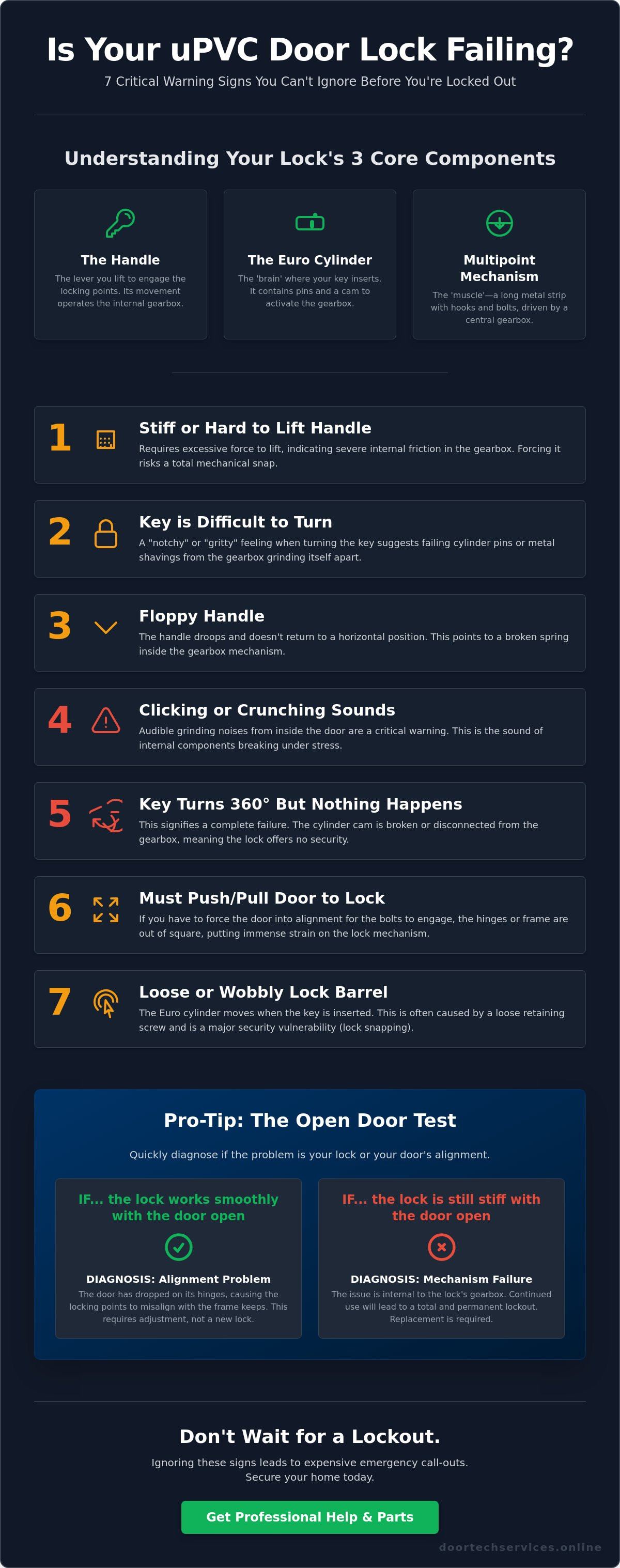
Understanding your door's anatomy is the first step to ensuring your home remains secure. A PVCu door lock isn't a single unit; it's a complex assembly of three primary components that must work in perfect harmony. These include the handle, the Euro cylinder, and the multipoint mechanism. When you notice signs a PVCu door lock is failing, the issue usually lies within the mechanical interaction of these specific parts.
The multipoint lock is the long metal strip running the full height of your door. It functions as a heavy-duty mortise lock, securing the door at multiple points into the frame simultaneously. While the Euro cylinder acts as the 'brain' where your key is inserted, the gearbox serves as the 'muscle.' This central gearbox translates the turn of your key or the lift of your handle into the movement of the locking bolts. Most mechanical failures occur here. Friction and metal fatigue eventually take their toll on the internal springs and cams. We see these issues daily in the field.
The Role of the Euro Cylinder
The Euro cylinder is the most critical component for daily operation. It houses a central cam that rotates when you turn the key. This cam engages directly with the multipoint gearbox to throw the bolts. If your key turns but nothing happens, the cylinder cam is likely broken or worn. These units are the easiest part of the system to replace. Upgrading to a 3-star anti-snap cylinder provides an immediate boost to your home security. It's a simple fix that prevents common entry methods like lock snapping.
How Multipoint Locking Mechanisms Work
Multipoint systems use a combination of hooks, rollers, and deadbolts to pull the door tight against the frame. This creates a weatherproof seal and high-level security. Most UK homeowners use a 'lift-to-lock' system. This action requires you to pull the handle upward before turning the key. This movement puts significant strain on the internal gears over time. You'll often see brands like Fullex, Yale, GU, or Era stamped onto the metal strip. Recognizing these names helps us source the exact replacement part for your repair. Identifying early signs a PVCu door lock is failing, such as a stiff handle or a grinding noise, can save you from a costly emergency lockout. Don't ignore the warning signs. We provide the technical precision needed to restore your door's functionality quickly.
The 7 Warning Signs a PVCu Door Lock is Failing
Identifying the signs a PVCu door lock is failing early is the difference between a simple maintenance task and a costly emergency. Intermittent faults are your biggest enemy. If your lock works "most of the time," it's actually in a state of terminal failure. Don't mistake alignment issues, where the door needs a simple hinge adjustment or repacking. Mechanical failure involves internal components grinding against each other. Act now while the door still opens. Once it seizes in the locked position, the repair becomes significantly more complex.
The handle feels stiff or requires force to lift.
The key is difficult to turn or feels "notchy."
The handle is floppy and doesn't return to horizontal.
You hear audible clicking or crunching sounds inside the door.
The key turns 360 degrees without engaging the bolts.
The door only locks when you pull or push the frame hard.
The lock barrel feels loose or moves when the key is inserted.
Warning Sign 1: The Handle Feels Stiff or Hard to Lift
Resistance when you lift the handle suggests the internal gearbox is fighting against heavy friction. Forcing the handle is a major mistake. You risk snapping the internal spindle drive or the gearbox drive entirely. This mechanical friction is similar to issues found in window mechanisms; you can learn more about these components in the ultimate guide to window hardware. If the handle feels heavy, the mechanism is likely dry or misaligned. Continuous forcing will lead to a total mechanical snap.
Warning Sign 2: The Key Won't Turn Smoothly
Don't assume it's just a worn key. A failing internal cylinder pin often causes that "catchy" feeling during operation. If the cam is misaligned, the key won't complete its full rotation. Pay attention to any "gritty" sensation. This usually means metal shavings are accumulating inside the lock housing. This debris indicates that internal components are literally grinding away. High-quality replacements should always meet the security standards for doors set by police initiatives to ensure long-term durability and resistance to snapping. If the key resists, the internal pins are likely reaching their limit.
Warning Sign 3: A Floppy or Loose Door Handle
A handle that droops or feels lifeless is a major red flag. This often points to a failed spring cassette inside the handle or a "tired" multipoint system. Check if the handle returns to a horizontal position on its own. If it hangs at an angle, the internal tension is gone. This is often the first of several signs a PVCu door lock is failing and shouldn't be ignored. If you notice this drooping, it's time to give us a call before the gearbox seizes completely. A floppy handle puts unnecessary strain on the gearbox every time you use the door.
Diagnostic Tests: Is it the Lock, the Door, or the Weather?
Don't panic if your key starts sticking or the handle feels heavy. You need to determine if you're facing a simple adjustment or a total mechanical breakdown. Identifying the specific signs a PVCu door lock is failing early can save you from a stressful emergency lockout. Before you call a technician, perform these quick diagnostic checks to isolate the root cause.
The Open Door Test
This is the most critical diagnostic tool for any PVCu door. It separates mechanical failure from frame or sash movement. Follow these three steps precisely:
Step 1: Open the door fully. Lift the handle to engage the bolts and turn the key to lock it while the door is still open.
Step 2: Evaluate the movement. If the lock operates perfectly while the door is open but jams when closed, the lock itself is healthy. Your problem is door alignment or frame/sash movement.
Step 3: Listen for grinding. If the handle feels stiff or the key resists while the door is open, your multipoint gearbox or lock cylinder is failing internally. This requires immediate hardware replacement.
Checking for Door Drop and Misalignment
UK weather is a major factor in door performance. PVCu frames expand in the summer heat and contract during winter. This movement often leads to "door drop," where the weight of the double glazing pulls the door off its original axis. Look for "witness marks" on your metal striker plates. These are silver scuff marks where the locking bolts are hitting the frame instead of sliding into the designated holes.
You can also perform the pencil test. Close the door and draw a light line on the frame along the top edge of the door. Open the door and check the line. If the line is significantly higher than the door's edge, the hinges have dropped. These alignment issues often mimic a broken lock.
Lubrication vs. Hardware Replacement
Sometimes a "failing" lock just needs maintenance. If the mechanism is dry, use a dedicated PTFE-based lubricant or graphite powder. Don't use WD-40. It acts as a degreaser and attracts grit that eventually gums up the internal pins. If you apply the correct lubricant and the grinding persists, the internal springs or gears are likely snapped. At this point, the hardware is no longer reliable. We recommend replacing the gearbox before the internal components seize completely, as a seized lock may require a destructive entry that increases your repair costs.
Why Multipoint Gearboxes Fail
The gearbox is the mechanical heart of your door. It sits inside the central cavity and translates your handle's movement into the locking action of the hooks and bolts. Most gearboxes rely on a central drive gear made of cast metal alloys. Over time, this component suffers from metal fatigue. Every time you lift the handle, the teeth on this gear endure significant pressure. Eventually, they shear off or crack. This internal collapse is one of the most common signs a PVCu door lock is failing and usually happens without warning.
Your daily habits also dictate the lock's lifespan. Slamming the door sends sharp shockwaves through the multipoint rail. This vibration loosens internal fixings and misaligns the drive gear. Additionally, poor-quality or perished gaskets create a physical barrier. If you have to pull the handle with extra force to compress a stiff seal, you are doubling the torque applied to the gearbox. This accelerated wear leads to a total mechanical breakdown within 24 to 36 months of the seal's initial degradation. We often see gearboxes that have literally shattered because the user was fighting a stubborn door seal every single day.
The Impact of Friction and Lack of Lubrication
Maintenance is frequently ignored by homeowners. You should grease the hooks, deadbolts, and rollers every 12 months to prevent friction. When one roller becomes stiff due to debris or rust, it creates a cascading failure. The central gearbox must work significantly harder to move the entire rail, which eventually snaps the internal spindle drive. Always use a high-quality PTFE or silicone spray for these parts. Never use standard WD-40 in the lock cylinder or gearbox. It acts as a degreaser and attracts grit, which eventually grinds down the delicate internal pins and gears.
Metal Fatigue and Spring Failure
A standard PVCu gearbox has a functional lifespan of roughly 10 to 15 years under normal conditions. The most frequent casualty is the internal return spring. If your handle feels "floppy" or fails to return to a horizontal position on its own, the spring has likely snapped. While the long metal rail (the multipoint strip) can last for decades, the central gearbox is the moving part that bears the brunt of daily use. It's the first point of failure in 90% of PVCu door issues. Replacing the gearbox early prevents the stress of a total lockout.
Don't wait for your door to jam completely and leave your home vulnerable. If your handle feels heavy or gritty, book a professional gearbox inspection with our local team today.
Choosing the Right Replacement Hardware
Recognising the signs a PVCu door lock is failing is the first step toward securing your home. The second step is ensuring you purchase the exact hardware needed for a seamless repair. Guesswork leads to frustration and leaves your property vulnerable. At Door-Tech Services, we prioritize precision because a lock that doesn't fit perfectly won't protect you effectively. Accuracy saves time and prevents the stress of a failed DIY attempt.
Measuring for a New Euro Cylinder
Accuracy is vital when replacing your cylinder. Open your door and locate the fixing screw on the edge of the door leaf. Measure from the center of this screw hole to the internal face of the door handle, then repeat for the external face. These two numbers form your size, such as 30/30 or 35/45. Offset sizes are common in thicker modern doors. Don't assume your door is symmetrical; always measure both sides independently.
Upgrade to a 3-star high-security cylinder to stop "lock snapping." This technique is a common threat across the UK, but anti-snap cylinders provide a certified barrier. Ensure the cylinder never protrudes more than 3mm from the external handle. A flush fit prevents intruders from gaining leverage with tools. If your current lock sticks out further than 3mm, it's a security risk that needs immediate correction.
Identifying Your Multipoint Gearbox
The gearbox is the mechanical heart of your door. If your handle feels heavy or won't lift, the gearbox likely needs replacing. Look for the manufacturer's name stamped on the long metal faceplate. You'll often see brands like Fullex, Fuhr, Mila, or Winkhaus. Identifying the brand narrows down your search significantly and ensures the internal components align with your existing locking points.
Measure the Backset: This is the distance from the front of the metal faceplate to the center of the keyhole. Standard UK sizes are usually 35mm or 45mm.
Verify the PZ Measurement: Measure from the center of the handle spindle to the center of the circular part of the key hole. A 92mm PZ is the industry standard for most modern PVCu doors, though older 70mm versions still exist.
Before you finalize your order, run through a quick compatibility check. Verify the brand, confirm the Backset, and re-measure your PZ distance. Getting these details right the first time ensures your door returns to full functionality without the need for an emergency locksmith. Your home's security depends on these specific dimensions. Browse our full range of replacement Multipoint Locks and Euro Cylinders to find the exact match for your door and restore your peace of mind today.
Secure Your Home Before the Lock Fails
Recognizing the signs a PVCu door lock is failing is the most effective way to prevent an expensive emergency. Most multipoint gearboxes are engineered for approximately 20,000 cycles; mechanical fatigue is a certainty as your door ages. Don't ignore a stiff handle or a key that requires force to turn. These symptoms indicate internal wear that leads to total failure. Proactive maintenance is always more cost-effective than an emergency locksmith call-out, which can cost £150 or more for labour alone during out-of-hours periods.
Door Tech Services is your specialist UK supplier of Euro Cylinders and Multipoint Locks. We provide expert technical support to help you identify the correct hardware for your specific door model. With our nationwide delivery on all door and window parts, you get the right components delivered straight to your door. Take control of your home security by replacing worn parts before they leave you stranded outside. You've got the expertise and the right parts at your fingertips to keep your property safe and functional.
Secure your home today with our range of High-Security Euro Cylinders and Multipoint Locks
Frequently Asked Questions
Can I replace just the gearbox or do I need a whole new multipoint lock?
You can replace just the central gearbox if the rest of the locking strip is in good condition. This typically saves you about £50 compared to buying a full 2200mm multipoint unit. Check the brand name on the faceplate, such as ERA or GU, to ensure a match. If the hooks or bolts on the outer strip are bent, replace the entire mechanism for total security.
Why is my PVCu door hard to lock when it's hot outside?
Heat causes PVCu frames to expand by up to 5mm, which frequently results in the locking points and keeps falling out of alignment. This physical shift is one of the most common signs a PVCu door lock is failing to engage smoothly. Use an Allen key to adjust the hinges and restore the 3mm gap between the door and the frame. Never force the handle during a heatwave.
How do I know if my door handle is broken or if it's the lock mechanism?
Test the handle by removing it and turning the spindle with a pair of pliers. If the spindle moves the locking bolts, your handle spring has simply failed. A replacement handle set costs between £15 and £40. If the spindle turns but the bolts don't move, the internal gearbox is broken and requires a professional replacement to restore function.
Is it safe to use WD-40 on my PVCu door lock?
Don't use standard WD-40 because it's a degreaser that attracts dust and creates a sticky sludge inside the cylinder. This residue eventually jams the pins and prevents the key from turning. Switch to a PTFE-based lubricant or a 3-in-1 dry specialist spray instead. Apply these lubricants every 6 months to ensure a seamless operation and prevent 85% of common mechanical lock failures.
How much does it cost to replace a PVCu door lock mechanism myself?
A replacement multipoint lock mechanism generally costs between £65 and £180 depending on the security level and brand. You'll need a screwdriver and roughly 30 minutes to complete the swap. Professional locksmiths in the UK often charge a labour fee of £70 to £95 for this service. Always measure your existing lock twice before ordering to avoid the cost of returning incorrect parts.
What is 'lock snapping' and should I upgrade my Euro cylinder?
Lock snapping is a technique where intruders break a standard Euro cylinder at its weakest point to gain entry in under 15 seconds. UK police statistics show that 25% of forced entries involve this method. Upgrade to a 3-star TS007 rated cylinder to provide a heavy-duty defence. These cylinders feature sacrificial snap lines that keep the central cam locked even if the outer part is broken.
How do I measure the PZ distance on my PVCu door?
Measure from the centre of the handle spindle to the centre of the circular part of the keyhole. This measurement is your PZ distance. The most frequent UK standard is 92mm, though older doors may use 70mm or 48mm configurations. Use a steel tape measure to get a reading accurate to 1mm. Getting this right ensures your new handles align perfectly with the existing locking mechanism.
My key is stuck in the PVCu door lock and won't turn, what should I do?
A stuck key is one of the final signs a PVCu door lock is failing and requires immediate, careful action. Stop turning the key to avoid snapping the metal blade inside the plug. Apply a small amount of dry lubricant and gently jiggle the key while lifting the door handle to relieve pressure. If it remains trapped, contact us to avoid a £150 emergency door replacement bill.



Comments