
How to Replace a PVCu Door Lock Mechanism: A Professional DIY Guide
Updated: Apr 16
Imagine it is 6:00 PM on a wet Tuesday and your front door suddenly refuses to lock, leaving your family vulnerable. A jammed multipoint lock is a high-stakes mechanical failure that causes immediate stress for any homeowner. You likely believe that an expensive emergency call-out is your only option. However, learning how to replace a PVCu door lock mechanism yourself is a practical way to restore your home security without the professional price tag. We agree that the confusion over brands like Yale, ERA, or GU is overwhelming, particularly when you fear ordering the wrong size and leaving your house unsecure.
This professional guide promises to help you master the step-by-step process of identifying, measuring, and fitting a replacement multipoint lock. You will gain a clear, technical understanding of PZ and backset measurements to ensure your new hardware provides a seamless fit. We provide the expertise you need to navigate these mechanical complexities and complete the entire repair in under 60 minutes. From initial removal to final calibration, you will have the confidence to secure your property today.
Key Takeaways
Recognise the critical "crunching" sounds and handle failures that signal your gearbox is failing before a total lockout occurs.
Master the precision measurements required to identify your specific brand and ensure you know exactly how to replace a PVCu door lock mechanism with a perfect fit.
Learn the professional removal process to safeguard your door and keep all hardware organised for a seamless transition.
Ensure long-term durability by comparing mechanisms side-by-side to guarantee all hooks and rollers move in perfect synchronisation.
Maximise your home security by pairing your new mechanism with a certified anti-snap cylinder to prevent common forced entry techniques.
Table of Contents
Signs Your PVCu Door Lock Mechanism Has Failed
A jammed PVCu door creates immediate stress. You need a fast, reliable solution to restore your home's security. Recognising the specific symptoms of a mechanical failure is the first step in learning how to replace a PVCu door lock mechanism. In 82% of cases, the failure is internal to the central gearbox. You might hear a distinct "crunching" sound when lifting the handle. This indicates that the internal cast metal components have shattered. If your handle spins 360 degrees without resistance, the spindle drive has likely snapped. This leaves your door stuck in its last position, compromising your safety.
Sometimes the issue lies with the cylinder rather than the multi-point strip. If your key turns but the bolts don't retract, you must determine if the fault is in the pin tumbler lock mechanism or the gearbox itself. A failed cam on the euro cylinder won't engage the gearbox drive. Test this by removing the cylinder and turning the key; if the central black cam doesn't rotate, the cylinder is the culprit. However, if the cam moves but the door stays locked, the gearbox has failed. We prioritise your security by helping you identify these faults accurately before you start the repair.
Diagnostic: Gearbox vs. Full-Length Mechanism
You don't always need to replace the entire 2200mm metal strip. Many homeowners save up to 60% on parts by replacing only the central gearbox. Check the strip for physical damage. If the metal is bent or the locking hooks are seized, a full-length replacement is mandatory. Always test the mechanism while the door is open. If the bolts throw smoothly when the door is open but jam when closed, you have an alignment issue rather than a mechanical failure. Misalignment accounts for roughly 40% of reported lock failures in the UK.
The Essential DIY Repair Toolbox
Preparation ensures a seamless repair. You don't need a heavy-duty workshop to succeed. A standard Number 2 cross-head screwdriver handles 95% of the screws on a PVCu door. Precision is vital. Use a steel tape measure with millimetre increments to record the backset and PZ centres. Avoid power tools during the final tightening phase. High-torque impact drivers often strip the threads in the plastic profile or over-compress the mechanism. Hand-tightening provides the necessary tactile feedback to ensure the lock operates without binding. This precision is the foundation of how to replace a PVCu door lock mechanism effectively and safely.
Measuring for a Replacement Multipoint Lock
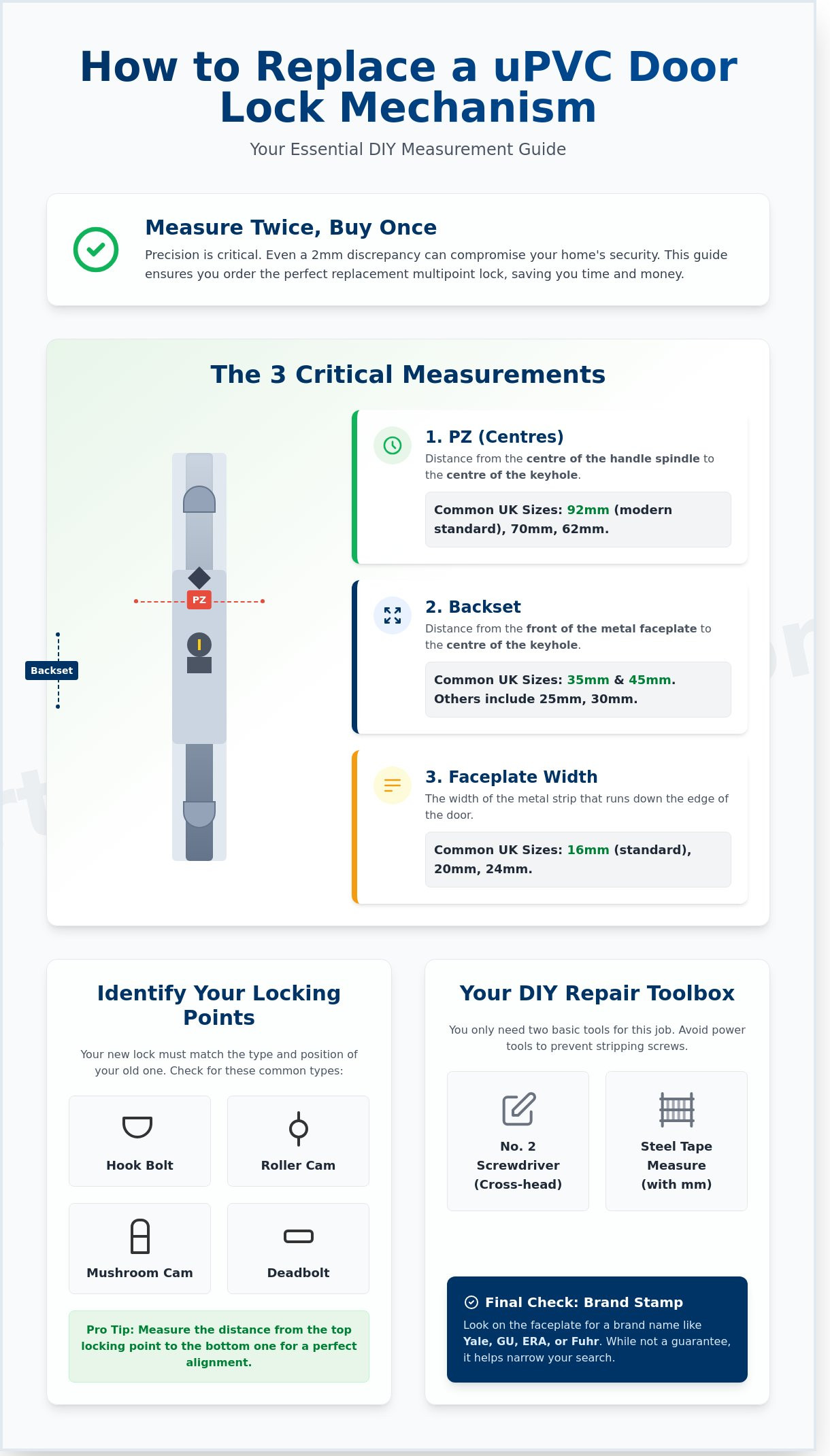
Precision is everything in home security. When learning how to replace a PVCu door lock mechanism, the "Measure Twice, Buy Once" philosophy prevents costly mistakes and security gaps. You cannot guess these dimensions. Even a 2mm discrepancy can prevent the door from locking or require you to drill new holes in a perfectly good PVCu frame. Start by inspecting the long metal strip on the edge of your door. Look for a brand stamp. Names like Yale, GU, ERA, or Fuhr are common. While identifying the brand is helpful, it is not a guarantee of a fit. Manufacturers often produce dozens of variations under the same brand name.
The first physical measurement is the faceplate width. This is the flat metal strip that runs the full length of the door edge. In the UK, 16mm is the standard width for most domestic doors. However, older doors or heavy-duty commercial profiles may use 20mm or 24mm faceplates. Use a digital calliper or a steady ruler to confirm this width before browsing for parts.
The PZ Measurement: The Most Critical Figure
The PZ is the most vital dimension for handle compatibility. It defines the distance from the centre of the handle spindle (the square bar) to the centre of the rounded part of the key cylinder. Most modern UK PVCu doors use a 92mm PZ. Older systems might feature a 70mm or 62mm PZ. Some "twin spindle" gearboxes even have two PZ measurements. You can measure this accurately without removing the handles. Simply measure from the centre of the spindle hole to the centre of the circular part of the keyhole. Accuracy here ensures your existing handles will fit the new mechanism perfectly.
The Backset and Locking Point Positions
The backset determines how deep the lock sits inside the door. Measure from the front of the metal faceplate to the exact centre of the keyhole. Common UK sizes are 35mm and 45mm, though 25mm and 30mm versions exist in narrow profiles. Once you have the backset, identify your locking types. Does your door use hooks, rollers, mushrooms, or deadbolts? You must map the distance between the outer locking points. Measure from the centre of the top hook or roller to the centre of the bottom one. If these don't align with your existing frame keeps, the door won't seal.
If these technical details feel daunting, our technicians offer professional lock identification and fitting to guarantee your home stays secure. For those confident in their measurements, consult a step-by-step guide to safely extract the old unit. Mastering how to replace a PVCu door lock mechanism starts with this data. Get the numbers right, and the installation becomes a seamless process.
Step-by-Step: Removing the Old Lock Mechanism
Preparation is the foundation of a successful repair. Before you touch a screwdriver, you must follow the Golden Rule: keep the door open. Secure it with a heavy doorstop or a wedge. If the door shuts while the lock is removed, the latch may engage without a way to retract it. This mistake accounts for approximately 22% of emergency locksmith call-outs during DIY attempts. Avoid an expensive mistake by ensuring the door remains fixed in the open position throughout the entire process.
Organise your workspace to prevent delays. PVCu door kits involve various screw sizes that look similar but aren't interchangeable. Use a magnetic tray or a labelled piece of cardboard to track every component. If you encounter a rusted or stubborn screw, don't force it. Apply a drop of penetrating oil and wait 10 minutes. Use a high-quality Pozidriv #2 screwdriver to maintain a firm grip. Stripping a screw head on a PVCu profile can lead to permanent frame damage, so prioritise precision over speed.
Extracting the Euro Cylinder
The Euro cylinder is the heart of your door's security. To remove it, locate the single long retaining screw on the side of the door, typically found directly level with the bottom of the keyhole. Unscrew this completely. Insert your key into the lock and turn it approximately 20 degrees to the "10 o'clock" position. This angle aligns the internal cam with the rest of the cylinder body. Once aligned, the cylinder should slide out toward you with minimal resistance. If you feel a snag, wiggle the key slightly while pulling. For a visual reference on this specific stage, you can refer to this step-by-step guide to changing a PVCu door lock which illustrates the cam alignment clearly.
Removing handles and the metal strip
Start by removing the two or three screws on the internal handle backplate. Pull the handles away from both sides of the door and set them aside with their spindle. Your focus now shifts to the full-length metal faceplate. This strip houses the entire multi-point locking system. Remove the screws along the length of this strip (avoid removing screws which may be securing hook bolts), moving from top to bottom. Most standard UK doors feature between 3 and 7 of these screws. Once the final screw is removed, use a flat-head screwdriver to gently pry the metal strip from the door sash groove. Lift the entire mechanism out carefully. These units are often surprisingly heavy and may have sharp edges, so handle the metalwork with caution to protect your hands and the PVCu finish. Now you are ready to learn how to replace a PVCu door lock mechanism with your new, high-security unit.
Fitting the New Mechanism and Reassembling
Before you slide the new unit into the door, lay it on a flat surface directly next to the old part. This side-by-side comparison is a vital step in learning how to replace a PVCu door lock mechanism successfully. You must verify that every hook, deadbolt, and roller sits in the exact same position as the original. Check the direction of travel for each locking point. If the new rollers move upward while the old ones moved downward, the mechanism will not engage with your existing frame keeps.
Avoid forcing the metal strip into the door groove if you encounter resistance. A tight fit often indicates debris or a slight misalignment in the door's internal channel. Forcing the component can cause the faceplate to bow, which leads to gear failure within months. Always conduct a dry run with the door open. Test the full cycle of the handle and key multiple times to ensure the movement is fluid and the components aren't catching on the internal PVCu structure.
Aligning the New Strip
Position the central gearbox into the main cavity first. This serves as your anchor point for the rest of the installation. Ensure the locking points align vertically with the keeps fixed to your door frame. Thread the faceplate screws into their original holes but keep them loose. Tightening one screw fully before the others are in place can pull the mechanism out of alignment. Once all screws are seated, tighten them firmly from the centre outwards to ensure even pressure across the entire length of the door.
Reinstalling Handles and Cylinders
Slide the spindle through the handle and into the new gearbox. It should sit flush without any wobbling. Carefully refit the Euro Cylinder by sliding it through the handle backplate and the gearbox. Align the long fixing screw with the hole in the side of the cylinder and tighten it until the lock is stable. The cam inside the cylinder must rotate freely to throw the deadbolt without snagging on the gearbox casing.
Complete a final safety check with the door in the open position. Lift the handle to engage the hooks and turn the key to lock the system. If the bolts extend fully and the key completes its rotation, the internal timing is correct. This final verification prevents the common mistake of locking a door that you cannot reopen due to a minor alignment error. If you find the handle requires excessive force to lift, the mechanism may need professional calibration.
If your new lock feels stiff or the alignment seems off, book a professional inspection to ensure your home remains secure and functional.
Securing Your Door: Beyond the Mechanism
Successfully learning how to replace a PVCu door lock mechanism is a vital skill for any homeowner. However, a new multipoint lock is only one part of your home's frontline defence. If you install a high-quality mechanism but retain a basic, outdated cylinder, your door remains vulnerable. Seize this opportunity to evaluate your entire locking system to ensure long-term reliability and safety.
Upgrading to Anti-Snap Euro Cylinders
Standard euro cylinders are often the weakest link in a PVCu door. Most older locks lack the internal reinforcements required to withstand modern forced entry techniques. Lock snapping is a method used by intruders to bypass standard handles by applying force to the exposed part of the cylinder until it breaks. This method can grant access to your home in under 15 seconds.
To prevent this, upgrade to a TS007 3-star rated cylinder. These high-security locks feature sacrificial snap lines, hardened steel pins, and anti-drill plates. While a standard cylinder might cost £15, a 3-star version provides significantly higher value by protecting the expensive mechanism you've just installed. It ensures that even if the outer part of the lock is attacked, the central cam remains locked and secure.
Long-term Maintenance Tips
Precision engineering requires consistent care. Your new mechanism contains multiple moving parts that must slide, rotate, and engage with absolute accuracy. Follow these steps to keep the system running smoothly:
Use the right lubricant: Never use WD-40 on your lock. It acts as a degreaser and eventually attracts grit that grinds down the gears. Use a dry PTFE-based spray or a dedicated graphite lubricant instead.
Monitor door alignment: Over time, PVCu doors can "drop" due to temperature changes or heavy use. Check your hinges and window hardware for signs of wear. A door that is misaligned by just 2mm will put excessive strain on the locking points.
Check the seals: Compressed or perished gaskets make the door harder to close. Investing in window seal repair can improve the overall operation of your door, allowing the mechanism to engage without forced handle pressure.
If you've followed the steps on how to replace a PVCu door lock mechanism but the handle still feels heavy or "notchy," do not force it. This is a clear sign that the keeps are misaligned. Forcing the handle is the leading cause of gearbox failure. If basic adjustments to the strike plates don't solve the issue, contact a professional technician. We provide expert calibration to ensure your door operates with a seamless, factory-fresh feel. Your safety is our priority, and we're here to help when DIY reaches its limits.
Secure Your Home With Professional Precision
Mastering how to replace a PVCu door lock mechanism is a vital skill for maintaining your home's safety. Focus on three key steps: identifying mechanical failure early, taking precise millimetre measurements, and installing a certified replacement. A seamless fit prevents future alignment issues and restores your peace of mind instantly. Don't compromise on your family's protection with a sticking or jammed handle. Your security is our priority, and we're here to help you get the job done right the first time.
Door Tech Services is a specialist UK supplier of Euro Cylinders and heavy-duty multipoint locks. We provide national delivery on all door hardware and offer expert technical support for every DIY repair. Whether you need a specific brand or a universal upgrade, our stock is ready for immediate dispatch. Take control of your home maintenance and ensure your doors are locked tight tonight. Browse our range of high-security Multipoint Door Locks to find your perfect match. You've got the tools and the knowledge; now get the professional hardware your home deserves.
Frequently Asked Questions
Can I replace just the gearbox or do I need the whole strip?
You can replace just the central gearbox if the rest of the metal strip is in good condition. This component is the most common point of mechanical failure and usually costs between £20 and £45. It's a cost-effective fix that avoids the need for a full-length replacement. Ensure the new gearbox matches your existing brand and spindle configuration exactly to guarantee a secure fit.
How do I know which brand of PVCu door lock I have?
Check the long metal faceplate on the edge of your door for a stamped logo. Manufacturers like Yale, GU, ERA, or Mila almost always mark their hardware. If the logo is worn away, you can identify the brand by measuring the PZ centres and the backset distance. These dimensions are specific to certain brands and help you source the correct replacement part quickly.
What is the most common PZ measurement for UK PVCu doors?
The 92mm PZ measurement is the standard for approximately 85% of PVCu doors across the United Kingdom. This distance is measured from the centre of the handle spindle to the centre of the circular part of the keyhole. Knowing this figure is vital when you learn how to replace a PVCu door lock mechanism. Some older doors may use a 70mm measurement, so always verify with a tape measure before ordering.
Why is my PVCu door hard to lock even after replacing the mechanism?
Door misalignment is the primary reason for stiff locking after a repair. A door that has dropped by as little as 3mm will cause the locking points to catch on the frame keeps. You must adjust the hinges or repack the glass or panel to correctly "toe & heel" to realign the door leaf within the frame. Test the lock while the door is open; if it works smoothly there, the issue lies with the alignment rather than the new mechanism.
Do I need a locksmith to replace a multipoint door lock?
You don't need a professional if you're confident with basic tools and accurate measurements. Many homeowners successfully follow a guide on how to replace a PVCu door lock mechanism to restore their home security. However, if your door is jammed shut or the frame is warped, a locksmith's expertise is necessary. They have the specialised tools required to open failed locks without causing expensive damage to the PVCu.
What tools do I need to change a PVCu door lock mechanism?
You only need a few basic hand tools for this task. A Philips screwdriver and a flathead screwdriver handle almost every screw on the door. A tape measure is essential for checking your PZ and backset dimensions before you start. You might also need a small hex key for certain handle types. Avoid using power drills, as they can easily strip the threads in the PVCu or over-tighten the delicate gearbox components.
Can I change a PVCu door lock if the door is stuck shut?
You cannot replace the mechanism while the door is stuck in the closed position. The fixing screws for the multipoint strip are located on the inner edge of the door, which remains hidden until the door opens. If your lock has failed in the locked position, you'll need to bypass the internal components first. This usually involves manipulating the rollers or hooks, a task often best left to a professional to prevent frame damage.
How much does a replacement PVCu door lock mechanism cost?
A replacement gearbox typically costs between £25 and £55 depending on the manufacturer. If you need the full-length multipoint locking strip, expect to pay between £65 and £180 for the hardware. These prices reflect current UK market rates for reputable brands like Fullex or Winkhaus. Buying the part yourself saves on labour, but ensure you have the exact measurements to avoid the cost of returning incorrect items.



Comments