
How to Measure a Multipoint Door Lock: A Step-by-Step Replacement Guide
Last Tuesday, a homeowner spent four hours trying to secure a jammed door while the evening temperature dropped to 5 degrees. This stressful situation often leads to a rushed purchase, yet industry reports suggest that 60% of DIY lock replacements are returned due to simple sizing errors. You don't have to guess and hope for the best. Learning how to measure a multipoint door lock with professional precision is the fastest way to restore your home's security and your peace of mind.
We understand the frustration of staring at a complex strip of metal and wondering if you're about to waste your hard-earned money on the wrong part. It's confusing when every brand seems to have its own standard. This guide promises to turn you into a sizing expert. We'll provide a clear, step-by-step breakdown of technical terms like PZ and Backset to ensure your replacement fits perfectly the first time. From identifying the rail width to measuring hook centres, you'll gain the technical confidence to fix your door without the typical DIY headaches.
Key Takeaways
Precision is everything when securing your home; understand why millimetre-perfect measurements are the only way to ensure your new lock functions correctly.
Master how to measure a multipoint door lock by focusing on the "Big Two"-the PZ centres and backset dimensions-to ensure total handle compatibility.
Achieve a seamless, flush fit by identifying the correct faceplate width and overall length required for your specific PVCu or composite door.
Guarantee long-term durability by mapping the exact position and type of locking points to match your door frame’s existing keeps.
Eliminate common installation delays by learning to avoid the #1 measuring mistake that compromises home security and hardware alignment.
Table of Contents
What is a Multipoint Lock and Why Measurement Matters
A multipoint door lock is the primary security standard for modern UK homes. Unlike a traditional mortice lock that secures a door at a single central point, this mechanism uses a long metal strip that runs the full height of the door. When you engage the handle, it triggers multiple locking points to grip the frame simultaneously. This three-point locking system, which often includes five or even seven points of contact, creates a formidable barrier against forced entry. It distributes the pressure evenly, making it significantly harder for an intruder to lever the door open.
Precision is everything when it's time for a replacement. These locks are not universal components. Variations of just 1mm or 2mm in specific dimensions can make a lock completely incompatible with your existing door preparation. If you buy a "close enough" match, you risk leaving your home vulnerable. A poorly fitted lock creates friction, puts strain on the internal gearbox, and eventually leads to a total mechanical failure.
Learning how to measure a multipoint door lock with accuracy is the only way to ensure a seamless, high-security installation that lasts for years.
Identifying Your Lock Brand and Type
Start by opening your door and examining the long metal faceplate. Most manufacturers stamp their logo directly onto the metal. Look for names like Yale, GU, Fullex, or Avocet. Identifying the brand narrows down the search immediately. Next, look at the type of locking points. You'll see hooks, deadbolts, or rollers. Finally, check the spindle type. A single spindle uses one solid square bar for both handles, while a split spindle allows the external handle to operate independently, acting like a night latch. Knowing these details prevents costly ordering mistakes.
Tools You Will Need for Accuracy
You don't need a massive toolkit to get this right, but you do need quality equipment. Grab a steel tape measure with clear millimetre (mm) markings. Avoid using a soft sewing tape or a ruler, as these lead to inaccuracies. Keep a pencil and notepad nearby to record the "Big Three" dimensions: the PZ, the backset, and the distance between the outer locking points. You'll also need a standard screwdriver. It's often easier to get a precise reading by removing the door handles first, giving you an unobstructed view of the lock cylinder and the internal mechanism.
Your safety is our priority. Taking five minutes to measure correctly now saves hours of frustration later. A professional-grade fit ensures your door operates smoothly every time you turn the key. Don't guess the dimensions. Use the right tools, follow the steps, and restore your home's security with total confidence.
The 'Big Two' Measurements: PZ Centres and Backsets
To learn how to measure a multipoint door lock correctly, you must focus on two primary dimensions: the PZ centre and the backset. These measurements determine if your new handle or gearbox will align with the existing apertures in your door. Precision is non-negotiable. Use a high-quality steel tape measure for every step. Always record your findings in millimetres. Even a tiny 2mm discrepancy will prevent your handles from seating properly, leaving your home's security compromised.
Open the door before you begin. Engage the locking mechanism by lifting the handle or turning the key. This ensures the internal components are in the correct position for an accurate reading. Accuracy at this stage saves time and prevents the frustration of ordering the wrong parts.
How to Measure the PZ Centre
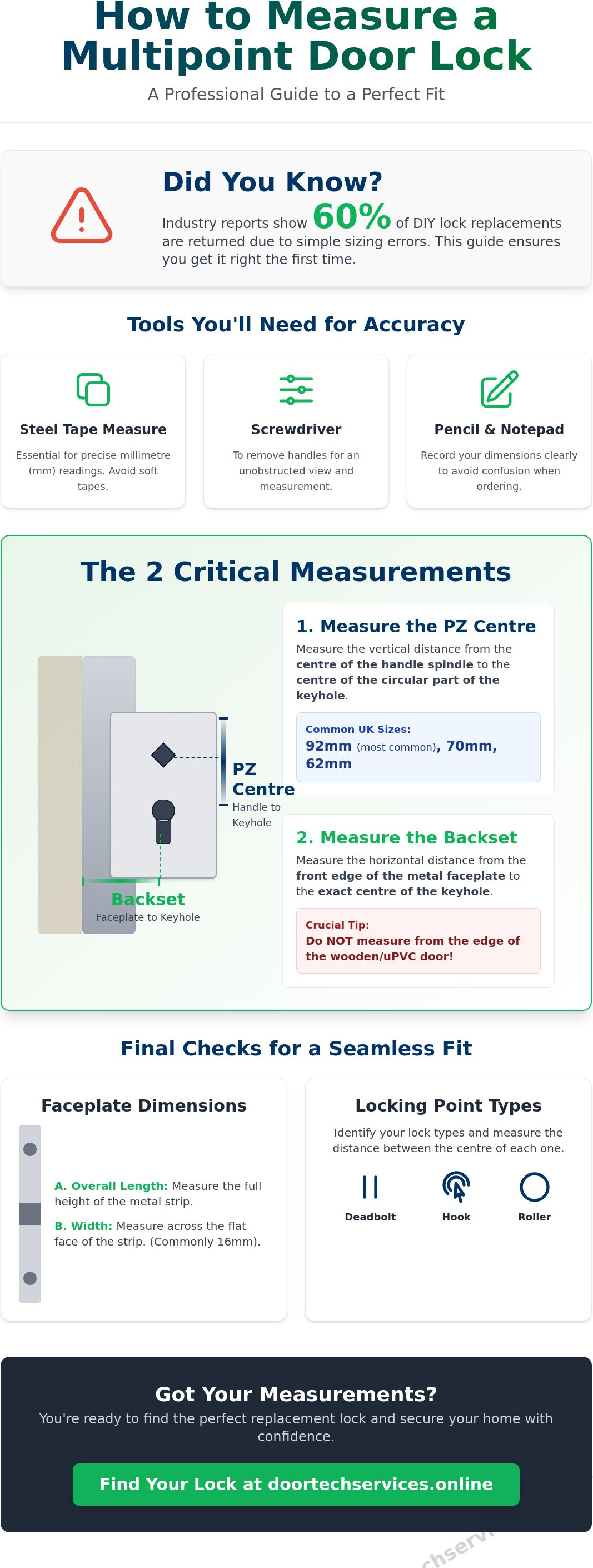
The PZ centre is the most vital measurement for handle compatibility. It represents the vertical distance between the two centres of the lock's operation. Specifically, PZ is the vertical distance from the centre of the handle spindle to the centre of the circular part of the keyhole.
In the UK, 92mm is the industry standard for the vast majority of modern PVCu and composite doors. You might also encounter 70mm or 62mm on older or specialized systems. If your measurement doesn't match these common figures, double-check your tape placement. Accuracy ensures a seamless restoration of your door's function. Identifying these dimensions correctly is the first step in knowing how to measure a multipoint door lock like a professional.
How to Measure the Backset
The backset determines how far the handle sits from the edge of the door. Measure from the flat outer edge of the metal faceplate to the exact centre of the keyhole. Do not measure from the door's edge or the weather stripping. You must measure from the metal strip itself to get a true reading of the gearbox depth.
Common UK backset sizes include:
25mm: Often found on slim aluminium frames.
30mm: Common in older uPVC profiles.
35mm: The most frequent size for modern PVCu doors across the UK.
45mm: Typically seen on timber doors or heavy-duty composite door systems.
Getting this right is the difference between a functional lock and a wasted afternoon. If you're struggling to identify these dimensions, our team provides expert lock identification services to get your home secure again. We prioritize your safety by ensuring every component fits with technical precision.
Faceplate Width and Overall Length
The faceplate is the long, flat metal strip that runs the entire vertical edge of your door. It's the most visible part of the locking mechanism and serves as the mounting point for all hooks, rollers, and bolts. Precision is vital when measuring this component. The strip must sit perfectly flush within the "eurogroove," which is the recessed channel manufactured into the door's edge. If the faceplate is too wide, the door simply won't close; if it's too narrow, the lock won't be stable, leading to mechanical failure and compromised security. While the length of many modern locks can be adjusted, the width is a fixed specification that you cannot change.
Understanding these dimensions helps you identify the correct replacement part without guesswork. For broader context on how these standards apply to home security, you can refer to the ultimate guide to window hardware.
This guide explains the standard UK hardware profiles that often share similar specifications with door locking systems.
Measuring Faceplate Width
Standard faceplate widths in the UK are typically 16mm or 20mm. You might encounter 24mm widths on older or heavy-duty timber doors. Use a high-quality steel tape measure or a digital calliper for an accurate reading. Ensure you measure only the metal strip itself. Don't include the plastic PVCu door profile or any rubber weather seals in your measurement. Since 16mm is the standard for the vast majority of UK PVCu doors, double-check your figures if you record a different size. Getting this right is a critical step in learning how to measure a multipoint door lock effectively.
Determining the Overall Length
To find the overall length, measure from the absolute top of the metal strip to the absolute bottom. Many modern multipoint locks are "cropable," meaning they're designed with serrated ends that a technician can cut down to fit your specific door height. However, you should still record the original length to help identify the specific brand and model. You should also pay close attention to the following details:
Screw Hole Positions: Note the distance between the mounting screws. Matching these ensures a faster, cleaner fit.
End Caps: Check if the ends are square or rounded, as this affects how the lock sits in the door.
Structural Integrity: Avoid drilling new holes into the door profile whenever possible; matching the original screw positions keeps the door frame strong.
If your current lock is 2200mm long but your door is shorter, don't panic. As long as the width and locking point positions match, a cropable version will work perfectly. Precision here ensures a seamless restoration of your home's safety. Knowing how to measure a multipoint door lock accurately prevents the frustration of ordering parts that don't align with your existing eurogroove.
Identifying and Mapping Locking Points
Locking points act as the 'teeth' of your door. They provide the physical connection between the door leaf and the frame. For a replacement to work, the type and position of these points must align perfectly with your existing 'keeps'. These are the metal-lined holes in your door frame. If you choose a lock with different spacing, you'll have to move the keeps. This often involves drilling new holes into the frame, which compromises both aesthetics and structural integrity. Precision at this stage prevents a simple repair from turning into a full frame replacement.
Alignment issues often lead to mechanical stress. If you find the door isn't sealing correctly despite the points being engaged, you might need to look at fixing draughty windows and doors to address misalignment or worn seals. A properly mapped lock ensures a seamless, airtight fit every time you lift the handle.
Locking Point Types: Hooks, Rollers, and Mushrooms
Different points serve different purposes. Hooks provide the highest level of security. They wrap around the keep to prevent intruders from jemmying the door open. Rollers are primarily designed for weather sealing. They are cylindrical and slide into the keep to compress the door against the frame. Mushrooms offer a hybrid solution. They slide into the keep and hook behind the metal plate. This prevents the door and frame from being pulled apart during an attempted break-in. Approximately 85% of modern UK residential PVCu doors use a combination of these points to balance security and weatherproofing.
Measuring the Distance Between Points
Precision is vital when learning how to measure a multipoint door lock. Start your measurement from the centre of the gearbox spindle hole. This is your zero point. Measure from this centre point to the centre of every locking point on the metal strip. Record these figures in millimetres for accuracy.
Record the distance to both the inner and outer points if your lock has multiple features.
Check the direction of travel. Lift the handle and observe if the points move up or down.
Note the overall length of the metal strip. Most standard strips are 2200mm, but they are often trimmed to size during installation.
Don't guess these dimensions. Even a 5mm discrepancy will stop the door from locking securely. If you're unsure about your measurements, contact Door-Tech Services for professional assistance and immediate peace of mind.
Troubleshooting Common Measuring Mistakes
Precision is your best friend when you learn how to measure a multipoint door lock. The most frequent error homeowners make is measuring in inches. The UK door industry operates exclusively in millimetres. A 1/16th of an inch discrepancy might seem minor, but it's enough to prevent a faceplate from sitting flush. Always use a metric tape measure or digital callipers for 100% accuracy. If you provide measurements in inches, you risk receiving a part that's slightly off-calibration.
Don't measure a lock strip that's visibly warped or distorted. If your door has been forced or the mechanism has seized, the metal can stretch or bend. This damage often adds 2mm to 4mm to your total length measurements. This leads to ordering hardware that won't fit the existing recesses. If the metal strip is damaged, measure the routing (the groove) in the door itself. This reveals the original dimensions the manufacturer intended.
Sometimes your measurements won't match standard stock sizes exactly. Most UK multipoint locks follow set patterns like a 92mm PZ or a 35mm backset. If you find a measurement like 34mm, it's almost certainly a standard 35mm backset with slight mechanical wear. Don't guess. If your figure is off by more than 2mm, stop and measure again. Always double-check your PZ and Backset before you click buy. These two figures determine if your handles and lock cylinder will actually line up.
Should You Replace the Gearbox or the Whole Strip?
The gearbox is the central engine of your lock. It does the heavy lifting every time you turn the key. If the long metal strip is straight and rust-free but your handle feels floppy, a gearbox replacement is a smart, cost-effective fix. It reduces waste and saves on shipping. However, replacing the full strip is often easier for DIYers. It ensures every locking point is brand new and perfectly timed. A full strip replacement typically takes 10 to 15 minutes less than a gearbox swap because you avoid fiddly dismantling.
Final Checklist Before Ordering
Accuracy prevents security delays. Run through this final list to ensure a seamless repair and total peace of mind:
Confirm the 'Big Three': Re-verify the PZ centres, the backset depth, and the faceplate width (standard widths are 16mm or 20mm).
Check the spindle type: A single 8mm spindle is the UK standard. Check if yours is a twin-spindle or an offset variety before ordering.
Verify locking positions: Measure the distance from the centre of the gearbox to each hook or bolt to ensure they match your frame keeps.
Place your order with confidence at Door-Tech Services for fast UK delivery. We understand that a broken lock is a security emergency. We stock heavy-duty components designed for long-term durability. Get the right part the first time and restore your home's safety today. Your security is our absolute priority.
Restore Your Home Security with Precision
Getting your measurements right is the only way to ensure your door remains secure and functional. You've now mastered the essentials: identifying the 92mm or 70mm PZ centres, pinpointing the backset depth, and mapping out every hook and bolt. Knowing how to measure a multipoint door lock correctly saves you time and prevents the frustration of a misaligned mechanism. A single millimetre can be the difference between a smooth operation and a compromised entrance. Don't leave your property's safety to guesswork when expert help is a click away.
Door Tech Services is a specialist UK hardware supplier dedicated to high-performance security solutions. We provide expert technical support to guide you through complex calibrations, ensuring your replacement part fits perfectly the first time. With national delivery on all security parts across the UK, you can restore your home's protection without delay. Take control of your home maintenance and ensure your family stays safe behind a door that locks exactly as it should. Precision is your best defence.
Frequently Asked Questions
Can I replace a multipoint lock myself?
You can replace a multipoint lock yourself if you have basic DIY skills and the correct measurements. Most replacements involve removing a few screws and sliding the old gearbox or strip out. However, 15% of DIY attempts result in alignment issues that compromise home security. If you feel unsure, contact a professional to ensure your door remains a secure barrier for your property.
What is the most common PZ size for UK PVCu doors?
The most common PZ size for UK PVCu doors is 92mm. This measurement represents the distance from the centre of the handle spindle to the centre of the keyhole. While 92mm is the industry standard for 85% of modern installations, some older doors use a 70mm or 48mm PZ. Always double-check this distance before ordering a replacement to avoid a costly 48-hour return process.
Do I need to know the brand of my door lock to replace it?
Knowing the brand isn't strictly necessary, but it makes finding a compatible part much faster. Look for names like Yale, GU, or ERA stamped on the metal faceplate. If the brand is missing, you must know how to measure a multipoint door lock accurately to find a match. Focus on the backset, PZ, and locking point positions to ensure a seamless fit.
What happens if I measure my backset incorrectly?
Measuring your backset incorrectly means the lock gear won't align with the existing handle and cylinder holes. A 35mm backset is standard, but even a 5mm error makes the lock unusable. This mistake forces you to either return the part or drill new holes, which can weaken the door structure. Accurate calibration of your measurements is vital for a heavy-duty, secure installation.
Are all multipoint door locks the same length?
Multipoint locks come in various lengths, typically ranging from 1,500mm to 2,200mm. While many full-length strips are 2,200mm long, they're designed to be trimmed to fit your specific door height. Over 60% of modern locks feature serrated ends for this purpose. Always measure the total length of your existing metal faceplate to ensure the new strip covers the entire door edge.
What is a 'split spindle' multipoint lock?
A split spindle lock uses a two-part spindle that allows the internal and external handles to operate independently. This setup ensures that once the door is shut, it cannot be opened from the outside without a key. It is a certified security feature found on roughly 40% of UK residential doors. This mechanism provides an extra layer of protection against unauthorized entry.
How do I measure a lock if the door is stuck shut?
You can still obtain the PZ and backset measurements while the door is stuck. Measure from the centre of the handle to the centre of the keyhole for the PZ. For the backset, measure from the edge of the door frame to the centre of the handle, subtracting the width of the frame overlap. Learning how to measure a multipoint door lock in this situation helps our technicians prepare for an emergency repair.
Can I cut a multipoint lock strip to the correct size?
You can cut many multipoint lock strips to size using a hacksaw. These cropable strips feature serrated teeth at the top and bottom, allowing for adjustments of up to 200mm. Ensure you don't cut into the locking points or the central gearbox mechanism. Check the manufacturer's specifications first, as 20% of high-security models have fixed lengths that cannot be modified without destroying the internal torsion springs.



Comments