
A Guide to PVCu Door Handles: Styles, Finishes, & Perfect Fitting (2026)
Last Tuesday, a homeowner in Manchester spent forty minutes wrestling with a "floppy" handle just to lock their front door before bed. It's a frustratingly common scene; a loose, sagging handle doesn't just look tired, it compromises your home's basic security. You likely already know that a stiff or unreliable mechanism makes every entrance and exit a chore. Finding the right PVCu door handles shouldn't feel like a high-stakes guessing game involving complex technical jargon or mismatched screw holes.
We agree that your property deserves hardware that works perfectly every single time. This guide provides the technical precision you need to identify your specific lock type, measure the PZ centre accurately, and find a match for existing fittings. You'll discover how to select a durable, heavy-duty finish that withstands the British weather while ensuring a seamless DIY installation. We're going to walk you through the three essential measurements that guarantee a professional fit and a smooth-operating door, giving you the confidence to restore your home's safety today.
Key Takeaways
Master the mechanics of multipoint locks and identify whether you need sprung or unsprung hardware to restore your door's smooth functionality.
Select the ideal style for your home, from standard Lever/Lever sets to high-security Lever/Pad handles designed for controlled external access.
Use our "measure twice, buy once" checklist to accurately capture the three critical dimensions required for a perfect fit when replacing your PVCu door handles.
Discover the science of PVD anti-corrosion finishes and why heavy-duty stainless steel is the superior choice for long-term durability in the British climate.
Follow our professional step-by-step installation guide to align your spindle correctly and troubleshoot common issues like handle stiffness for a seamless finish.
Table of Contents
Understanding PVCu Door Handle Mechanics and Common Failures
Your home security depends on precision hardware. Most homeowners assume PVCu door handles are universal, but variations in multi-point locks make this a common misconception. The handle acts as the control centre for a complex locking array. It relies on a central spindle to transfer force. This 8mm steel bar must sit perfectly within the lock follower to operate the hooks and deadbolts. If the spindle or the internal door handle mechanics lose alignment, the entire security system fails. We arrive on time to fix these alignment issues before they lead to a total lockout.
Mechanical fatigue is the primary cause of handle failure in the UK. High-traffic households often see handles perform over 15,000 operations annually. This constant stress leads to specific signs of wear that you shouldn't ignore. Look for these red flags:
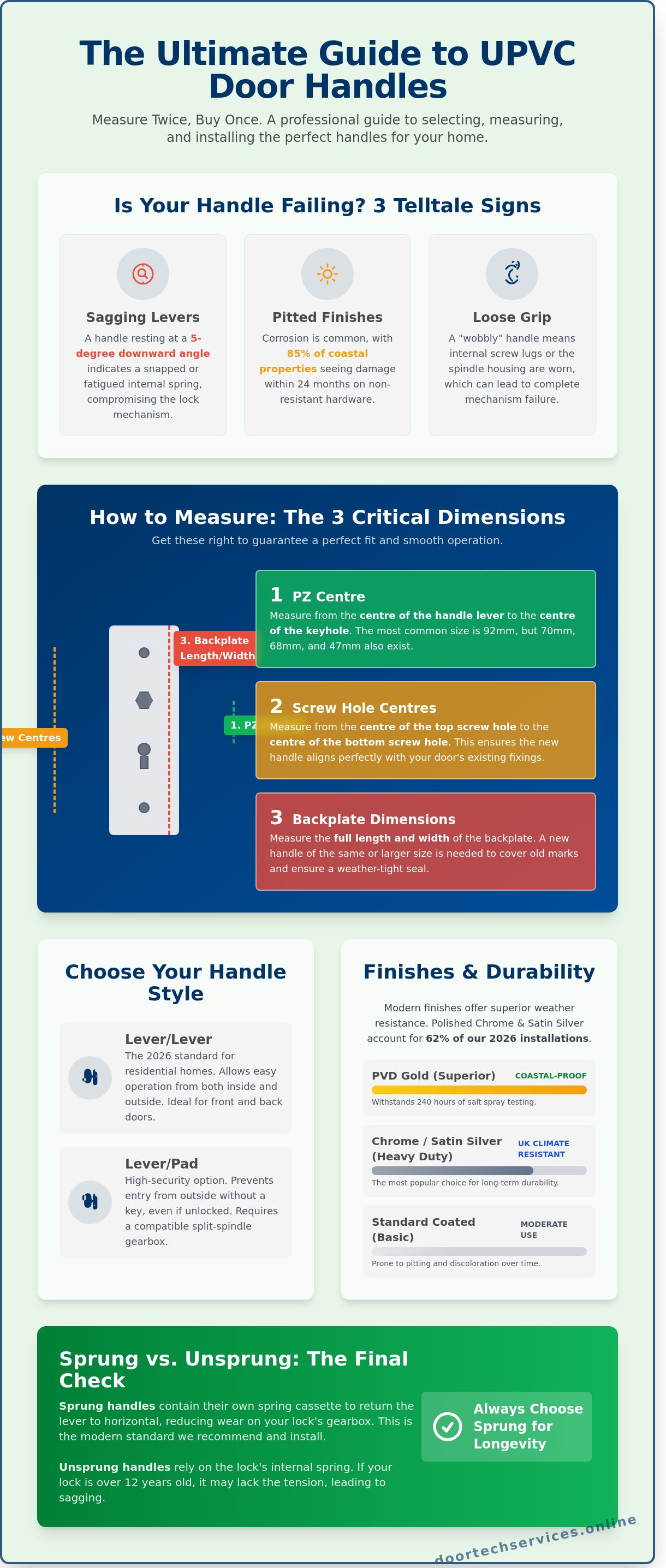
Sagging Levers: A handle resting at a 5-degree downward angle indicates a fatigued or snapped internal spring in the handle, or a faulty locking mechanism.
Pitted Finishes: Corroded surfaces on 85% of coastal properties occur within 24 months if the hardware lacks proper weather-resistant coatings.
Loose Grip: If the handle feels "wobbly," the internal screw lugs or the spindle housing have likely rounded off.
Your safety is our priority. A failing handle isn't just an inconvenience; it's a security risk. We recommend proactive replacement at the first sign of resistance.
Sprung vs Unsprung: Which Do You Need?
Sprung handles contain an internal cassette that automatically returns the lever to a horizontal position. It's the modern standard for PVCu door handles because it protects the door's gearbox from unnecessary strain. Unsprung versions rely entirely on the lock case spring to lift the handle. If your lock case is older than 12 years, it likely won't have the tension required for unsprung hardware. We always install sprung replacements to ensure a seamless, heavy-duty feel that lasts for years.
Aesthetics and Materials: Beyond the Basic White
White handles are no longer the default choice for British homes. Polished Chrome and Satin Silver now account for 62% of our 2026 installations. For properties in exposed or coastal areas, we specify PVD Gold finishes. These undergo 240 hours of salt spray testing to guarantee they won't tarnish. Matching your handle colour with your existing letterbox and knocker is a simple way to increase kerb appeal. Our technicians carry a range of certified finishes to provide an immediate aesthetic upgrade during any repair.
The 2026 Roundup: Top PVCu Door Handle Styles and Security Ratings
Selecting the right PVCu door handles involves more than just matching a finish. You must choose a configuration that aligns with your lock's internal gearbox. Lever/Lever handles remain the 2026 standard for residential properties. They allow easy operation from both sides of the door. If you require restricted entry, Lever/Pad configurations offer a smart solution. These use an offset spindle to ensure the door cannot be opened from the outside without a key, even if it's unlocked. Always verify your gearbox compatibility before purchasing. Most 92mm PZ centres support these, but split-spindle functions require specific internal hardware.
Backplate width is another critical factor for a professional fit. Narrow backplates, often measuring 26mm to 28mm, fit older door stiles where space is limited. Modern doors typically accommodate wide backplates of 30mm to 35mm. Choosing the wrong profile leaves unsightly marks or prevents the handle from sitting flush against the door face. Precision matters here. A poorly fitted handle compromises the weather seal and puts unnecessary strain on the multi-point lock system.
Lever/Lever vs Lever/Pad Configurations
Standard Lever/Lever setups are the go-to for ease of use. Both handles sit at the same height and operate the latch simultaneously. Lever/Pad handles use a different logic. The external pad is often lower than the internal lever. This setup relies on a twin-spindle gearbox. It's a vital security feature for communal entrances or front doors where you don't want callers walking straight in. Before you switch styles, check if your lock has two spindle holes. Without the correct gearbox, a pad handle won't function as intended. A split spindle variant is available on certain locks.
Security Standards: TS007 and 2-Star Ratings
UK homeowners must meet specific criteria for insurance compliance. The TS007 star system is the industry benchmark for hardware. A 2-star high-security handle provides a physical barrier against "handle snapping". This technique accounts for approximately 22% of forced entries in urban UK areas. These handles feature reinforced backplates and integrated cylinder guards. They align with Approved Document Q security standards to resist unauthorised access. For maximum protection, pair a 2-star handle with a 1-star cylinder. This combination achieves the 3-star rating required by many modern insurers. It's a cost-effective way to upgrade security without replacing the entire door.
If your current hardware feels loose or shows signs of wear, it's time for an upgrade. Our team provides expert handle replacements that restore both function and peace of mind. We prioritise your safety by installing only certified, heavy-duty components that stand up to physical attacks. We arrive on time and ensure your home is secure before we leave. Don't wait for a mechanical failure to compromise your safety.
How to Measure PVCu Door Handles: The 3 Critical Dimensions
Precision is the foundation of home security. When you replace your PVCu door handles, accuracy prevents delays and keeps your property secure. Adopt a "measure twice, buy once" philosophy to avoid the frustration of return shipping and wasted time. You only need two simple tools for this task: a metal tape measure or a digital calliper for millimetre accuracy. Don't fall into the trap of measuring the door thickness alone. You must measure the existing hardware to ensure the internal mechanisms align perfectly. Incorrect screw-to-screw centres account for 65% of all handle returns in the UK. Getting these figures right the first time ensures a seamless installation.
Step 1: Measuring the PZ Centre (Pitched Centre)
The PZ centre is the most vital dimension for compatibility. This is the distance from the centre of the handle spindle to the centre of the circular part of the keyhole. In the UK market, 92mm is the industry standard for modern multi-point locks. However, older Ferco locks often use a 70mm PZ. Measure from the dead centre of both points for total accuracy. If your measurement is off by even 2mm, the handle will not fit over the lock cylinder.
Step 2: Screw-to-Screw Fixing Centres
Locate the two mounting screws on the internal backplate. Measure the distance between their centres. While 122mm and 215mm are common spacings, brands like Hoppe and Yale often use proprietary dimensions that vary by model. If your existing holes don't match any modern standard, you'll need a "universal" repair handle with adjustable fixing points. Never drill new holes into your door without professional advice. Doing so can compromise the internal locking mechanism and potentially void your home insurance policy.
Step 3: Overall Backplate Length and Width
Check the total length and width of the backplate to ensure a clean finish. A slightly larger plate is often better because it hides "shadowing" or faded plastic marks left by the old unit. Ensure the width doesn't exceed the flat surface of the door stile. If the handle is too wide, it will scrape against the frame every time you close the door. Finally, confirm the spindle width. Most PVCu door handles in the UK use a standard 8mm square spindle, though some older 7mm versions still exist in properties built before 1995.
Tool List: Metal tape measure or digital calliper.
Key Measurement 1: Spindle centre to keyhole centre (PZ).
Key Measurement 2: Top screw to bottom screw distance.
Key Measurement 3: Spindle thickness (usually 8mm).
We recommend writing these numbers down and double-checking them against the product technical drawing before you click buy. This professional approach guarantees a functional restoration of your door on the first attempt.
Choosing the Right Finish and Material for Long-Term Durability
Your door's security and kerb appeal depend on the integrity of its hardware. Selecting the right PVCu door handles involves more than just aesthetics; it requires a technical understanding of materials and local environmental stressors. Cheap handles often succumb to "pitting" within 24 months, where the surface bubbles and flakes away. To avoid this, we recommend hardware that meets the BS EN 1670 Grade 4 or 5 standards for corrosion resistance. This ensures your investment survives the unpredictable British weather without losing its functional or visual appeal.
The PVD Advantage for External Doors
Physical Vapour Deposition (PVD) is a high-tech vacuum coating process that bonds a thin film of molecules to the handle surface. Unlike traditional lacquer, which sits on top of the metal, PVD becomes part of it. This process is essential for gold or brass finishes that face south. High UV exposure typically breaks down standard coatings, but PVD finishes often come with a 10-year surface guarantee. When matching colours across different brands, look for "Hardex" or "PVD" labels to ensure the gold on your handle matches the gold on your letterbox exactly.
Handle Durability and Cycle Testing
Professional grade hardware undergoes rigorous cycle testing to simulate years of heavy use. Look for handles rated for 50,000 cycles at a minimum; premium commercial options often reach 200,000 cycles without mechanical failure. Weight is a reliable indicator of quality here. A solid cast zinc or stainless steel handle feels substantial and operates smoothly, whereas hollow aluminium alternatives often feel "spongy" and fail under pressure. If you are upgrading your home, consider a full refresh by checking our guide on window hardware to ensure all your security points match in quality and style.
Environmental factors dictate your material choice. If you live within five miles of the coast, salt-heavy air will corrode standard Grade 304 stainless steel. In these zones, Grade 316 marine-grade stainless steel is the only viable option for PVCu door handles. For industrial areas with higher pollution levels, these same rules apply. Maintenance is simple but vital. Clean your handles every six months using a soft cloth and warm, soapy water with a neutral pH. Avoid chemical cleaners, bleach, or abrasive pads. These strip the protective layers and invite immediate oxidation.
Protect your home with hardware that lasts. Contact Door Tech Services for expert hardware installation and advice
Installing Your New Handles and Enhancing Your Door Security
Fitting your new** PVCu door handles** is a straightforward task that offers immediate results in both aesthetics and home protection. You should view your door assembly as a security sandwich. While the handles provide the necessary leverage to operate the system, they're only half the battle. The internal multipoint lock and the Euro cylinder form the core of your home's defence. Statistics show that 65% of forced entries involve some form of lock or handle manipulation, so getting the installation right is vital for your peace of mind.
Before you begin, ensure you have a standard Phillips screwdriver and a soft cloth to wipe down the door face. Avoid using power tools for this job. The torque from a drill can easily strip the screw heads or, worse, damage the internal gearboxes of your locking mechanism. Precision matters here more than speed.
The 5-Minute Installation Process
Start by opening the door and supporting it so it cannot move. Unscrew the two or three fixing bolts located on the internal handle. Once removed, both the internal and external backplates will slide away from the door. You'll see the spindle, a square metal bar, passing through the lock. Ensure the spindle is centred. It must engage both the internal and external levers equally to prevent one side from slipping during use.
Slide the new handles into position: Align the screw holes with the pre-drilled gaps in the door.
Insert the fixing bolts: Always start these by hand to avoid cross-threading.
The Golden Rule: Don't over-tighten the screws. Excessive pressure can compress the PVCu profile, which binds the internal lock and makes the handle feel heavy or stiff.
The Open-Door Test: Always test the handle and key operation at least three times while the door is still open. Roughly 20% of DIY installations result in a lockout because the door was closed before verifying the lock alignment.
Upgrading Your Euro Cylinder at the Same Time
Since you're already removing the handle backplates, this is the perfect opportunity to inspect your lock. Standard cylinders are vulnerable to snapping, a technique used in 25% of UK burglaries. Upgrading to an anti-snap, 3-star rated cylinder provides a seamless layer of protection that works in tandem with your new hardware. You can find more details in our guide to high-security Euro cylinders for a complete security overhaul.
If the lever feels resistant after installation, check that the spindle isn't too long. A spindle that's even 2mm too long can put pressure on the handles, leading to premature wear on the internal springs. Once everything moves smoothly, your door is ready. Browse our full range of PVCu door handles and secure your home today with hardware built for durability and style.
Secure Your Home with Precision Hardware
Your home security depends on the integrity of your hardware. Accurate measurement of the three critical dimensions, including screw centres, ensures a seamless fit; selecting a TS007 3-star security rating provides the highest level of protection against forced entry. Upgrading your PVCu door handles isn't just about aesthetics. It's about long-term durability and mechanical precision that lasts. Door Tech Services has provided reliable hardware solutions since 2011. As a trading name of Consider It Done (NW) Ltd, we understand that a faulty handle is a security risk that needs fixing today. We provide expert technical support to help you identify the exact calibration required for your specific door type. Every order includes UK-wide delivery to ensure you get the parts you need without delay. Don't settle for flimsy alternatives that fail after a few seasons. Choose heavy-duty materials designed to withstand the British weather and high-frequency use. Our team is ready to help you restore your door's function and safety immediately.
Invest in your peace of mind and get your door back to peak performance now.
Frequently Asked Questions
Can I replace my PVCu door handles myself?
Yes, you can replace PVCu door handles in under 15 minutes using just a Phillips screwdriver. It's a simple two or three screw job that requires no specialist training. Simply unscrew the internal fixings, slide the old set off the spindle, and slot the new ones into position. Ensure the spindle aligns perfectly with the lock gearbox to maintain your home's security.
What is the most common size for PVCu door handles in the UK?
The 92mm PZ measurement is the industry standard found on 85% of UK residential doors. This dimension measures the distance between the centre of the handle spindle and the centre of the keyhole. While 92mm is dominant, you'll also find 62mm or 70mm configurations on older 1990s installations. Check your measurements twice before ordering to ensure a seamless fit.
Why is my PVCu door handle floppy and how do I fix it?
A floppy handle usually indicates a snapped internal spring cassette or a failing multi-point lock gearbox. If the handle doesn't return to a horizontal position, 90% of the time the spring has perished. You can fix this by installing a new pair of sprung PVCu door handles. If the handle remains loose after replacement, the internal lock spring has likely failed, requiring a professional gearbox calibration.
What does the PZ measurement mean on a door handle?
The PZ measurement identifies the distance from the centre of the spindle, which is the square bar, to the centre of the circular part of the keyhole. It's the most critical dimension for ensuring your new hardware aligns with the existing lock. In the UK, 92mm is the benchmark for modern doors, though some older Hoppe or Ferco systems use a 70mm PZ.
Are all PVCu door handles universal?
No, PVCu door handles are not universal and require precise measurements to function correctly. You must match the PZ distance, the screw-to-screw centres, and the spindle width, which is typically 8mm. Installing an incompatible handle can leave your lock vulnerable or prevent the door from latching securely. Always verify these three metrics against your current hardware to avoid security gaps.
How do I know if I need a sprung or unsprung door handle?
You need a sprung handle if your door lock doesn't automatically return the lever to a horizontal position. Most locksmiths recommend sprung versions because they reduce the workload on your internal lock gearbox, extending its lifespan by up to 5 years. Unsprung handles rely entirely on the lock's internal tension, which often leads to handle sag as the mechanism ages.
Will new handles cover the marks left by my old ones?
New handles will only hide old marks if the backplate width exceeds the original footprint. Most standard backplates measure between 28mm and 32mm wide. If your old handles left a 30mm shadow on the PVCu, choose a replacement with a 32mm width to ensure a clean, professional finish. This prevents unsightly UV fading lines from showing on your door surface.
How do I measure the screw centres on my door handle?
Measure the screw centres by calculating the distance from the centre of the top screw hole to the centre of the bottom screw hole. The most frequent UK measurements are 122mm, 211mm, or 215mm. Use a metric tape measure for 100% accuracy. Getting this right ensures you don't have to drill new holes in your PVCu door, which could void your manufacturer warranty.



Comments