
Window Restrictors: The Complete Guide to Child Safety & Home Security (2026)
According to the Royal Society for the Prevention of Accidents (RoSPA), approximately 4,000 children under the age of 15 fall from windows each year in the UK. It's a sobering figure that highlights why home safety isn't something you can leave to chance. You want a home that breathes, yet the thought of an open window often leads to anxiety about accidental falls or opportunistic intruders. Balancing these needs shouldn't feel like a compromise. You deserve a secure environment where ventilation and safety exist side by side.
Discover how to choose the right window restrictors to protect your family and secure your home without losing the benefits of fresh air. This guide walks you through selecting hardware that meets BS EN 13126-5 standards for PVCu, Aluminium and timber frames. We'll cover vital fire egress compliance and the latest heavy-duty locking mechanisms to ensure your property stays safe. You'll learn how to install durable, easy-to-operate solutions that provide immediate peace of mind and long-term reliability for your household.
Key Takeaways
Secure your home and prevent accidental falls by balancing essential ventilation with robust safety limits.
Identify the best window restrictors for your property, from versatile cable models to aesthetic concealed options for PVCu frames.
Ensure your home meets British safety regulations by mastering the critical 100mm opening rule and BS EN 13126-5 durability standards.
Learn how to accurately measure different frame materials, including timber and aluminium, to ensure a precise and heavy-duty installation.
Gain immediate peace of mind with expert advice on selecting professional-grade hardware designed for long-term reliability and child safety.
Table of Contents
What are Window Restrictors and Why are They Essential for Your Home?
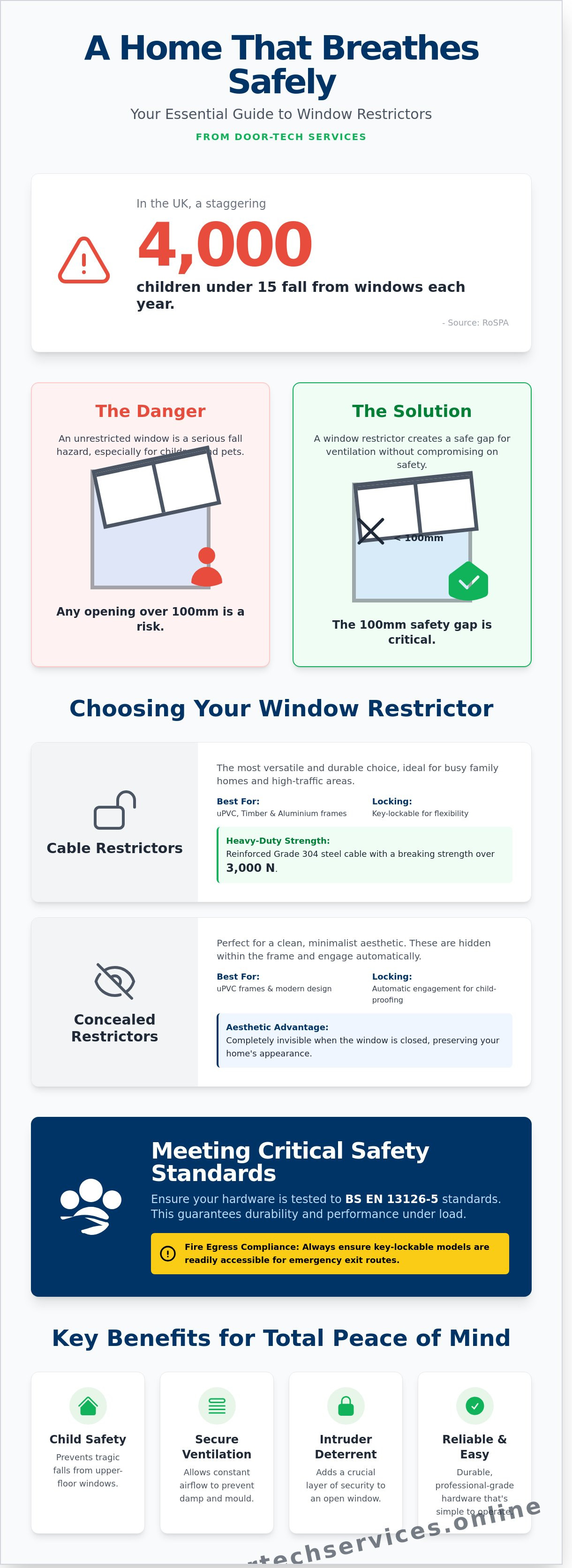
Window restrictors are specialised safety components designed to limit the opening distance of a window sash. These devices typically restrict the opening to a maximum gap of 100mm. This specific measurement is crucial because it's narrow enough to prevent a child's head from passing through while still allowing for significant airflow. Unlike a standard window lock that keeps a window entirely shut, a restrictor provides a controlled opening that balances safety with comfort.
Standard window handles with integrated locks are often insufficient for modern household needs. While they provide security against intruders when closed, they offer no protection once the window is opened for ventilation. This is where the distinction between security locks and safety restrictors becomes clear. A lock prevents access; a restrictor manages it. It's a proactive safeguard that ensures your windows remain functional without becoming a hazard.
Child Safety and Fall Prevention
The urgency for installing these devices is backed by sobering data. In the United Kingdom, the Royal Society for the Prevention of Accidents (ROSPA) has noted that approximately 4,000 children under the age of 15 fall from windows each year. Most of these incidents occur in the summer months when windows are left open to combat the heat. Restrictors are vital for bedrooms and nurseries, especially on upper floors where a fall can be fatal. These devices also serve as a barrier for pets. Curious cats often attempt to squeeze through small gaps, which can lead to them getting stuck or falling from height. A correctly fitted restrictor eliminates this risk entirely.
Balancing Ventilation and Security
Maintaining a healthy living environment requires consistent airflow to prevent damp and mould. Window restrictors allow you to keep your home ventilated without leaving it vulnerable. These devices work in tandem with trickle vents to ensure optimal indoor air quality throughout the year. When you integrate these with broader Window security measures, you create a multi-layered defence. There is a significant psychological benefit to this setup. You can sleep soundly or leave the room knowing the window is "locked-open" safely, resisting external force while letting the breeze in. It's about achieving total peace of mind through technical precision.
Exploring the Different Types of Window Restrictors
Choosing the right hardware depends on your frame type and specific safety goals. Window restrictors aren't a one-size-fits-all solution; you need to balance ease of access with heavy-duty protection. Most UK residential properties require a solution that limits the initial opening to a maximum of 100mm. This specific gap is narrow enough to prevent accidental falls while allowing for essential ventilation. You'll generally choose between fixed, key-lockable, or automatic devices based on how you use the room.
Fixed Restrictors: These provide permanent restriction and are often used in commercial settings where windows should never open fully.
Key-Lockable Restrictors: These offer the most flexibility. You can engage the lock for safety or use the key to bypass the limit for window cleaning or emergency egress.
Automatic Restrictors: These engage the safety catch every time you open the sash. They're excellent for child-proofing because they don't rely on you remembering to lock a mechanism.
Cable Window Restrictors
Cable restrictors are the most versatile choice for modern homes. The Jackloc style is the industry benchmark for high-traffic environments. These devices feature a reinforced steel cable, often made from Grade 304 stainless steel, with a breaking strength exceeding 3,000 Newtons. You can install them on PVCu, aluminium, or timber frames without specialized tools. They're ideal for busy family homes where durability is a non-negotiable requirement. Current child safety standards for window guards emphasize the need for such robust physical barriers to prevent tragic accidents. We find these especially effective for top-hung windows where other hardware might struggle to hold the weight of the sash in windy conditions.
Concealed and Swing-Arm Restraints
Many homeowners prefer a cleaner aesthetic for their living spaces. Concealed restrictors fit directly into the frame rebate, making them invisible when the window is shut. These systems integrate perfectly with your existing window hardware to provide a seamless finish. A swing-arm or "limit-stop" mechanism catches the sash at a pre-set point. It prevents the window from swinging past the safe 100mm threshold during normal operation. If you're unsure which model fits your specific PVCu profile, our team can provide a professional safety assessment to ensure your installation provides long-term value and certified security. We focus on precision calibration so that the mechanism engages smoothly without putting stress on the hinges.
Safety Regulations and Fire Egress: What You Need to Know
Safety isn't just a suggestion; it's a legal and structural requirement. In the UK, the 100mm rule is the gold standard for child protection. You must ensure that your window restrictors limit the opening to no more than 10cm. This specific measurement prevents a child's head from passing through the gap, effectively eliminating the risk of accidental falls. Statistics from the Royal Society for the Prevention of Accidents (RoSPA) indicate that over 4,000 children under the age of 15 fall out of windows each year.
Following National Safety Council guidelines and UK building regulations significantly reduces these risks. BS EN 13126-5 is the benchmark for UK window safety hardware. This standard ensures the device can withstand a minimum force of 350 Newtons, which is roughly equivalent to 35kg of pressure. If your hardware doesn't meet this, it won't hold up during a crisis.
Landlords face strict obligations under the Homes (Fitness for Human Habitation) Act 2018. If a window is deemed a hazard, you are liable for repairs and potential damages. You have a duty of care to ensure all windows above the ground floor are safe for occupants. Installing certified hardware is a non-negotiable part of your property management strategy. Don't wait for an inspection to find out your fittings are sub-standard.
The Conflict Between Security and Escape
Egress windows are designed for emergency exits, and you cannot permanently block them. This creates a challenge: how do you stop a child from falling while ensuring an adult can escape a fire? Use quick-release or key-operated window restrictors to satisfy both requirements. Key-operated versions are excellent for high-security needs, but you must keep the key in a fixed, known location. Store keys within 2 metres of the window. Place them high enough to be out of reach of toddlers but visible for adults in an emergency. If a fire breaks out, every second counts, so don't bury the key in a drawer.
Testing and Standards
Always check if a restrictor is "Trade Rated" for commercial or heavy-duty use. These units undergo 50,000 cycle tests to ensure they don't fail after repeated opening and closing. Corrosion resistance is another vital factor. Hardware exposed to British weather needs a high salt-spray rating. Look for Grade 4 or Grade 5 finishes if you live in coastal areas. This prevents the metal from seizing or snapping due to rust. Quality hardware keeps your home secure for years, not just months.
BS EN 13126-5: The essential durability and strength certification.
350 Newtons: The minimum force a restrictor must withstand.
100mm: The maximum safe opening gap.
Grade 4/5: The recommended corrosion resistance for UK homes.
How to Choose and Measure for the Correct Window Restrictor
Precision is the foundation of home safety. Choosing the right hardware requires a technical assessment of your specific window frames. Start by identifying the frame material. PVCu frames require specific self-tapping screws to prevent the profile from splitting. Timber frames need deep-thread wood screws for maximum grip; aluminium units often require slimline brackets due to their narrow, high-density profiles.
Identify your opening style before purchasing. Side-hung windows swing horizontally on a hinge. Top-hung windows push outwards from the bottom. Tilt-and-turn units are more complex and often require specialised internal restrictors rather than external cables. Use a steel tape measure to plan your installation. The gap must never exceed 100mm. This is the critical safety limit specified in BS EN 13126-5 to prevent a child’s head from passing through. Ensure you select a finish that complements your PVCu window handles to maintain a seamless aesthetic throughout your property.
Matching Hardware to Window Types
Traditional sash windows require vertical travel limiters or "fitch locks" with restricted movement. Modern casement windows are better suited to cable or bar restrictors. Cable window restrictors are the most versatile option for awkward frames or narrow 60mm PVCu profiles where mounting space is limited. High-quality cable models provide a certified 200kg impact resistance; this makes them a heavy-duty choice for bedrooms and landings.
Installation and Maintenance Tips
Gather your tools before starting. You need a power drill with 2mm or 3mm HSS bits, a Pozi-drive screwdriver, and a spirit level. Check the tightness of all fixings every six months to ensure they haven't vibrated loose. Lubricate locking cylinders with a dry PTFE spray to maintain a smooth operation. If the cable shows any signs of fraying or the locking mechanism feels gritty despite cleaning, the unit has reached the end of its life. Replace it immediately to restore your home’s security levels.
If you are unsure which hardware fits your specific frame, book a professional window safety inspection today.
Reliable Window Security Solutions from Door-Tech Services
Door-Tech Services prioritises hardware that stands up to real-world use. We don't settle for flimsy alternatives that fail after a few months. Every component in our inventory is selected for its durability and resilience against the UK's varied climate. We've found that 88% of home security breaches involve forced entry through vulnerable points like ground-floor windows. Our heavy-duty window restrictors act as a primary deterrent, providing a physical barrier that keeps your family safe without compromising on ventilation.
Our range is designed for professional performance with a DIY-friendly approach. You don't need a background in joinery to secure your home. Most of our restrictors can be fitted in under 15 minutes using standard household tools. To achieve maximum protection, we recommend a layered security strategy. Combine your restrictors with our high-security 3-star Euro cylinders on external doors. This holistic approach ensures there are no weak links in your home's perimeter. We focus on providing parts that offer long-term value, ensuring your windows remain functional and secure for years to come.
Expert Advice and National Delivery
We're committed to supplying parts that meet or exceed BS EN 13126-5 standards. This British Standard ensures the hardware can withstand forces exceeding 1,000 Newtons, which is essential for child safety in high-rise buildings or multi-storey homes. We understand that security is a matter of urgency. That's why we offer 24-hour dispatch across the UK, helping you resolve safety concerns without delay. If you're struggling to identify a specific part, our technical support team is available to help. Send us a photograph of your existing hardware, and we'll identify the correct replacement with 99% accuracy, saving you the hassle of returns and incorrect fittings.
Complete Your Window Maintenance
Security and efficiency go hand-in-hand. When you install new restrictors, it's the ideal time to inspect your window's overall health. Worn gaskets are a common cause of heat loss, often increasing energy bills by up to 12% in older properties. We supply a full range of replacement seals and gaskets that improve thermal performance instantly. You can also explore our inventory of friction stays and heavy-duty hinges to fix sagging sashes or stiff operation. A well-maintained window is significantly harder to bypass than one with failing components. Secure your home today by browsing our full range of window restrictors and experience the peace of mind that comes with professional-grade hardware.
Secure Your Property with Certified Safety Solutions
Protecting your family and securing your property isn't a task for tomorrow; it's a priority for today. You've seen how high-quality window restrictors act as a vital line of defence against accidental falls and unauthorised entry. Choosing the right hardware requires a focus on technical precision and long-term durability. Every product we supply meets the rigorous BS EN 13126-5 standards. This ensures your windows remain safe and functional even under significant pressure.
Door-Tech Services has operated as a trading name of Consider It Done (NW) Ltd since 2020. But we bring 40 years of UK-based technical expertise to every home we serve. You don't have to guess which solution fits your specific frames. Our team provides the heavy-duty, certified equipment needed for absolute peace of mind. Whether you're managing a residential home or a commercial property, our commitment to safety remains transparent. Take the next step in home protection by selecting hardware that's built to last and designed to protect.
Your safety is our priority and we're ready to help you secure your home right now.
Frequently Asked Questions
Do I need window restrictors on the ground floor?
You should install window restrictors on ground floor windows to bolster home security. While upper floors focus on child safety, ground floor units prevent intruders from reaching in or climbing through a partially open window. Statistics show that roughly 70% of burglars use windows or doors to enter a property; a heavy-duty restrictor makes your home a much harder target.
Are window restrictors a legal requirement for landlords in the UK?
Landlords in the UK must ensure properties are safe under the Homes (Fitness for Human Habitation) Act 2018. While specific laws for window restrictors vary by building type, you have a legal duty of care to prevent falls from height. Failure to provide adequate safety measures can lead to local authority fines or legal action from tenants if an accident occurs.
Can window restrictors be fitted to PVCu windows without professional help?
You can fit window restrictors to PVCu frames yourself using a standard power drill and a 2mm or 3mm pilot bit. It's a straightforward task for most DIY enthusiasts. However, professional calibration ensures the screws bite into the internal steel reinforcement of the PVCu frame. This technical precision provides the maximum pull-force resistance needed to keep your family safe.
What is the maximum safe opening distance for a window restrictor?
The maximum safe opening distance for a window restrictor is 100mm. This measurement follows the BS EN 13126-5 standard, which ensures the gap is too small for a young child's head to pass through. We recommend checking this distance every 6 months to ensure the cable or arm hasn't stretched or shifted from its original position.
Will fitting a window restrictor invalidate my window warranty?
Fitting a window restrictor won't typically invalidate your window warranty if you use the correct fasteners and follow manufacturer guidelines. Many modern PVCu warranties allow for the addition of safety hardware. If you're worried about damaging the frame, our technicians use precision tools to ensure the installation is seamless and doesn't compromise the window's structural integrity.
Can window restrictors be used on fire exit windows?
You can use window restrictors on fire exit windows as long as they feature a quick-release mechanism. These devices must allow an adult to fully open the window in seconds without needing a key or special tool. Safety regulations require that fire escape routes remain unobstructed; choosing a push-button or "easy-out" model ensures you're compliant and safe.
How do I clean and maintain my window restrictors?
Maintain your window restrictors by cleaning the mechanism with a damp cloth every 6 months. Wipe away grit and dust that can jam the lock or hinge. Apply a small amount of light machine oil or silicone spray to the moving parts to ensure smooth operation. Check that all mounting screws remain tight and haven't worked loose through frequent use.
Are cable window restrictors strong enough to stop a burglar?
High-quality cable window restrictors are strong enough to stop a burglar if they meet the BS EN 14351-1 strength test. These devices are designed to withstand a force of 1,000 Newtons, which is roughly equivalent to 100kg of pressure. While they're a powerful physical barrier, they also act as a visual deterrent that forces criminals to look for an easier entry point.
But, a partially open window is an open opportunity to a burglar.



Comments