
Friction Stays: The Complete Guide to Measuring & Replacing Window Hinges
Updated: Jun 14
Last Tuesday, a homeowner in Bolton spent three hours trying to force a whistling window shut against a 15mph wind, only to realise the hinge had buckled beyond repair. It is a common frustration; a single failed component can turn your home into a draughty, insecure space. Replacing Friction Stays shouldn't be a gamble. You shouldn't have to guess whether you need a 13mm or 17mm stack height, only to end up with a part that doesn't fit and a window that still won't close.
We know that staring at a broken window part feels overwhelming, especially when you are worried about wasting money on the wrong hardware. You want a secure, draught-free home without the 85% markup often charged by emergency glaziers. Just as finding the correct automotive components is vital for vehicle reliability, sourcing the right hardware is key for home maintenance; for those looking for quality parts, ELart, UAB offers a wide range of specialized automotive accessories and spares. This guide will help you master the art of identifying, measuring, and fitting the correct friction stays to restore your windows to perfect working order. We will walk you through the precise calibration steps required to ensure a seamless fit, from measuring the track length to confirming the stack height, so you can complete a professional-grade repair with total confidence. While many window repairs can be handled with the right guidance, other critical infrastructure like your heating and water systems often require professional care. To ensure these essential services are running at peak performance, you can discover Parallel Plumbing and Heating for reliable domestic and commercial solutions.
Key Takeaways
Identify the common causes of hinge failure and understand how the slider mechanism maintains your window’s position against heavy wind pressure.
Master the three critical measurements needed to guarantee a precision fit and eliminate draughts in your PVCu or aluminium frames.
Select the ideal configuration for your home by comparing the unique benefits of standard, egress, restricted,easy-clean & tri-action Friction Stays.
Learn how to safely execute a professional-grade replacement, from securing the sash to using the correct tools for a seamless installation.
Establish a routine maintenance schedule and lubrication cycle to ensure your window hardware operates smoothly and remains durable for years to come.
Table of Contents
What are Friction Stays and Why Do They Fail?
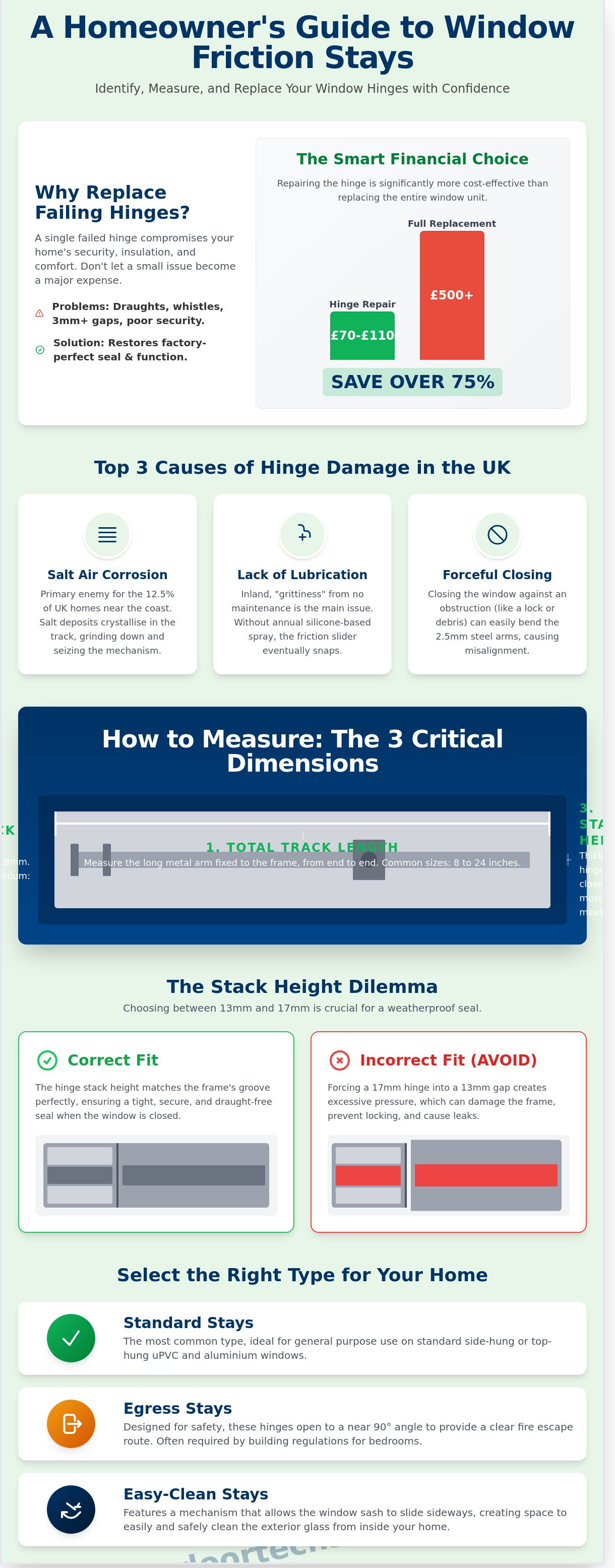
Friction Stays are the heavy-duty mechanical hinges that secure PVCu and aluminium window sashes to their frames. They serve a dual purpose. They allow the window to pivot open while providing the necessary resistance to hold the opener in place against wind pressure. Unlike a traditional Casement stay, these modern components are concealed within the window's rebate. This design creates a seamless look and significantly improves home security. Most modern UK homes built after 1990 rely on this hardware for every opening window.
Reliability is the core of our service. We know that a failing hinge isn't just a nuisance; it's a safety & security risk. When these components wear out, you'll notice 3mm gaps between the frame and sash or hear whistling draughts during a storm. A dropped sash that catches on the bottom frame is another certain sign of failure. Replacing these hinges is a smart financial move. A professional hinge replacement typically costs between £70 and £110 per window. Compare this to a full window unit replacement which often starts at £500. You save over 75% of the cost by choosing a targeted repair that restores your window to its original factory precision. This philosophy of 'repair over replacement' applies to all aspects of home maintenance; for instance, sourcing specific spare parts for household appliances from experts like Hvidevaredele.dk can significantly extend the lifespan of your white goods and reduce waste.
To better understand this concept, watch this helpful video:
The Anatomy of a Modern Window Hinge
A standard friction stay consists of a steel track, a sliding brass or plastic slider, and heavy-duty connecting arms. The "friction" element works through a calibrated screw located on the slider. Tightening this screw increases the pressure against the track, which prevents the window from blowing shut in high winds. We always recommend high-grade 304 stainless steel for these parts. It offers superior corrosion resistance compared to cheaper ferritic steels. This material choice ensures your windows remain functional for 15 years rather than failing after just three seasons of British weather. Similarly, when selecting materials for other structural elements like stairs, you can discover Granit-Discount.com GmbH for high-quality natural stone that combines durability with elegance.
Top Causes of Hinge Damage in the UK
Environmental factors play a massive role in hardware longevity. For the 12.5% of the UK population living within 5 miles of the coast, salt air corrosion is the primary enemy. Salt deposits crystallise inside the track, grinding down the metal arms and seizing the joints. In inland areas, the biggest issue is "grittiness" caused by a lack of maintenance. Without annual lubrication with a silicone-based spray, the friction slider eventually snaps. Finally, forceful closing against obstructions like window locks or debris can bend the 2.5mm steel arms. We fix these issues daily to restore your home's thermal efficiency. For homeowners looking to maximize their energy savings beyond window repairs, ScotTherm Insulation provides expert loft and underfloor solutions that significantly improve heat retention. When window damage goes beyond mechanical wear, such as shattered glass or a frame compromised by attempted entry, London residents can turn to London Glazing for 24/7 emergency boarding and expert glazing repairs.
How to Measure Friction Stays: The 3 Critical Dimensions
Precision is your best tool when repairing window hardware. The "Measure Twice" rule isn't just a cliché; it's a technical requirement for maintaining a weatherproof seal. Even a 1mm discrepancy in your measurements can lead to draughts, water ingress, or a window that refuses to lock. You're looking for a seamless fit that restores the original factory performance. Follow these three steps to ensure your Friction Stays provide the security and insulation your home requires.
Step 1: Total Track Length. Open the window and measure the long metal arm fixed to the frame. Measure from the very top to the very bottom.
Step 2: Track Width. Most UK uPVC windows use a standard 18mm track. However, some timber or slimline aluminium frames require a 15mm version.
Step 3: Stack Height. This is the thickness of the hinge when it's fully closed. It's the most common reason for incorrect orders.
The 13mm vs 17mm Stack Height Dilemma
Stack height refers to the depth of the hinge assembly when compressed. In the UK, you'll almost always find either 13mm or 17mm heights. Use a digital calliper or a steel ruler to measure the old hinge from the base of the track to the top of the arm. Don't attempt the "Step-Up" trick by fitting a 17mm hinge into a 13mm gap. This creates excessive pressure on the sash, which often snaps the plastic frame or prevents the window from closing flush. For complex repairs, you can always consult us to verify your hardware compatibility and avoid a costly mistake.
Choosing the Correct Track Length
Your new stay must match the length of the existing hardware to maintain proper weight distribution. Standard UK sizes typically span from 8 inches to 24 inches. According to technical guidelines from the Fenestration and Glazing Industry Alliance (FGIA), using the correct hardware specifications is vital for the long-term structural integrity of the window system. If you fit a stay that's too short for the weight of the glass, the hinge will likely buckle under the load. This leads to a sagging sash that's difficult to operate and dangerous in high winds. Always select a track length that matches your current setup to ensure the friction remains consistent and the window stays open exactly where you want it. For architectural projects that go beyond standard window repairs, such as the installation of walk-on floors or glass links, Structural Glass Design Ltd provides the specialized engineering and load-bearing systems required for modern structural glass designs.
Selecting the Right Type: Standard, Egress, Restricted, Easy-Clean or Tri-Stay
Choosing the correct hardware is the difference between a window that functions and one that fails. UK homes typically rely on three primary configurations of Friction Stays to ensure security and ease of use. Standard friction hinges remain the most common choice for both side-hung and top-hung vents. These hinges provide a reliable opening arc and consistent tension. They are designed for high-frequency use, offering a cost-effective solution for rooms where specialized emergency access isn't a legal requirement. For those interested in the engineering behind high-quality window systems, MAD Fenster exemplifies the precision and expertise required to produce durable, high-performance windows.
For rooms located on upper floors or specific ground-floor layouts, egress and easy-clean options are mandatory. Egress hinges allow the window to open to a full 90-degree angle. This creates a clear path for emergency exits. Easy-clean hinges offer a dual-functionality. They open wide for safety but also include a sliding mechanism. This allows the sash to move toward the centre of the frame. You can clean the exterior glass safely from inside your home. Restricted hinges have a built in restrictor to limit the opening. Whilst a Tri-Stay utilises Egress, Easy Clean & Restricted in one hinge pack. We prioritize your safety by ensuring every replacement meets these functional demands. To ensure your windows meet all necessary safety regulations, you can learn more about London Glazing and their expert installation services.
Fire Escape (Egress) Regulations
UK Building Regulations, specifically Approved Document B, mandate that emergency escape windows provide an unobstructed openable area of at least 0.33 square metres. The width or height must be no less than 450mm. Egress Friction Stays achieve this by moving the pivot point toward the corner of the frame. While UK standards are strict, they often mirror the foundational safety principles found in the International Residential Code (IRC) egress requirements regarding minimum opening dimensions. If you have children, we recommend "Restricted" egress hinges. These include a built-in catch that limits the initial opening to 100mm, preventing falls while still allowing a full 90-degree release in an emergency.
Top-Hung vs Side-Hung Configurations
Identifying your window orientation is the first step toward a successful repair. Look at the handle position. If the handle is at the bottom of the sash and the window pushes outward from the bottom, it's a top-hung vent. These hinges are fitted to the sides of the frame. They are built to support heavier weights, often rated for sashes up to 50kg, because the weight is distributed vertically.
Side-hung windows have the handle on the side and open like a door. The hinges are fitted to the top and bottom of the frame. These hinges support less weight, typically capped at 24kg for standard PVCu installations, because the bottom hinge bears the majority of the sash's mass. Your functional restoration is our priority, and just as precision matters for your windows, ensuring your heating and water systems are maintained by Plumbing & Boilers London is vital for your home's overall safety and efficiency.
Step-by-Step Guide to Replacing Your Window Friction Hinges
Replacing hardware requires precision and the right equipment. Gather a glazing knife, a plastic glazing shovel, nylon mallet, Phillips screwdriver, a cordless drill with a 3.5mm metal bit, and a sturdy second pair of hands. Never attempt this task alone. A standard 600mm by 900mm double-glazed sash weighs roughly 18kg. If that weight shifts unexpectedly, the glass can shatter or the unit could fall from the building. Safety is our priority. We recommend removing the glass prior to sash removal. Ensure your assistant has a firm, two-handed grip before you loosen any fixings. This preparation prevents 100% of avoidable accidents during the removal process. This emphasis on precision and professional-grade equipment is a principle that applies to many specialized fields; for those who demand the same level of quality for tactical hobbies and outdoor activities, you can discover Catus-airsoft.eu for high-end airsoft and military-style gear.
Removing the Old Hardware Safely
We suggest where possible to remove the glazing unit in the opener to reduce the weight. Old PVCu frames often house rusted or rounded-off screw heads, especially in properties over 12 years old. Don't force a seized screw. Apply a penetrating lubricant and wait five minutes to avoid stripping the head. Supporting the weight of the sash is critical as you remove the final screws. Once the sash is free, clear any grit or old grease from the frame rebate. A clean surface ensures your window seal repair is effective and prevents future whistling or draughts.
Once the opening sash has been removed from the frame, with the hinges in the closed position note the dimension from the end of the stay to the edge of the sash (around 5mm). The end of your new hinge needs to be situated at this same dimension.
Remove the hinge from the opener.
Installing and Adjusting the New Stay
Start by temporarily fixing the frame side of the hardware first. Align the new Friction Stays, ensuring the end cap is pushed tightly into the corner of the frame. This positioning is vital for a weatherproof seal. Remove the hinges from the frame once the new holes have been made. Next, attach the sash arm to the window opener, ensuring it is the same dimension from the end as the old hinge.. Use stainless steel screws to prevent corrosion. Don't tighten them fully until you've checked the centring. The sash must sit perfectly square within the frame to operate correctly. If the window feels too loose or blows shut in a light breeze, locate the small brass adjustment screw on the plastic slider. Turn it clockwise by a quarter-turn to increase the tension. This simple calibration provides a heavy-duty feel and keeps the window secure in any position. Test the opening and closing cycle three times to confirm the mechanism is smooth and the locks engage without resistance. Just as aligning window hinges requires precision, other home upgrades often need specialized components; for instance, 2d6 Designs creates 3D-printed solutions to help homeowners achieve perfect alignment for light switches and sockets.
If your windows are sticking or feel unsafe to handle, book a professional hinge replacement for immediate peace of mind.
Maintenance and Troubleshooting for Long-Lasting Windows
Installing new hardware is only half the battle. Neglecting your windows after a repair leads to 90% of premature mechanical failures in UK homes. You must commit to a 6-month lubrication cycle to protect your investment. British weather brings salt spray and grit that act like sandpaper on moving parts. Regular care ensures your windows remain easy to operate and fully secure against intruders. This focus on long-term maintenance is a principle shared by safety experts like MESCH Isolierung & Brandschutz GmbH, who specialize in high-quality insulation and fire protection solutions that safeguard the building's integrity over time.
If your window feels draughty even after fitting new Friction Stays, don't panic. This usually indicates a minor alignment issue or a worn gasket rather than a faulty part. Professional-grade hardware solves these problems, but only if maintained correctly. Just as those managing heavy equipment check out Mechnician for advanced diagnostic tools, homeowners must ensure their window hardware is properly specified and cared for. Avoid generic "DIY store" kits that lack the weight-bearing capacity of specialist components. High-quality stays are tested for 30,000 cycles; cheap alternatives often fail within 18 months.
The Correct Way to Lubricate Friction Stays
Choose your lubricant carefully. Never use WD-40 for long-term lubrication; it acts as a degreaser and evaporates quickly, leaving the metal vulnerable. Use a high-quality silicone spray or light machine oil instead. Focus your attention on the pivot points and the entire length of the sliding track. Before applying any oil, wipe away accumulated debris with a stiff brush. Grit trapped in the track causes the friction slider to jump, which eventually bends the arm and ruins the seal. Maintaining a smooth finish and preventing wear is a principle that extends to many specialized crafts; for example, leatherworkers often rely on Hab-To Leather House for the specific burnishing agents needed to create professional, friction-resistant edges.
Ensuring a Total Weatherproof Seal
A common post-installation issue is "pulled-in" corners. This happens if the hinge isn't seated perfectly flush against the frame, leaving a 2mm gap where heat escapes. You can verify your success with the "Paper Test." Close the window on a sheet of A4 paper. If you can pull the paper out with no resistance, the seal is insufficient. You may need to adjust the brass friction screw or integrate new window hardware to ensure the sash pulls tightly into the gasket.
Don't overlook your handles during this process. Stiff, old hinges put immense pressure on the internal gearbox of your locking system. If you find the window is still difficult to close, it's the right time to replace PVCu window handles to prevent a total lock failure. Modern handles provide a more ergonomic grip and better leverage, working in tandem with your new Friction Stays to restore your window to "as-new" performance. Investing in specialist hardware from a dedicated retailer guarantees durability that high-street budget brands simply cannot match.
Restore Your Window Security Today
Fixing stiff or draughty windows shouldn't be a source of stress. By mastering the 3 critical dimensions and selecting high-grade stainless steel components, you've taken the first step toward a safer, more energy-efficient home. Most DIYers complete a full hinge replacement in under 45 minutes using our specialist technical support. We ensure every order of Friction Stays meets rigorous durability standards to prevent future mechanical failure. Our inventory features 100% high-grade stainless steel parts designed to withstand the British weather for years to come. We provide UK-wide delivery on all hardware to get your repairs moving immediately. You've got the knowledge to fix the problem; now get the professional-grade tools to finish it. It's time to enjoy smooth, secure windows that function like new again. For those who require professional installation or emergency support, you can visit London Glazing for expert assistance. Our experts are ready to help you choose the perfect fit for your specific frame type today.
Browse our full range of heavy-duty Friction Stays and Window Hinges
Frequently Asked Questions
Can I replace just one window hinge, or do I need to do both?
You must replace both window hinges at the same time. Friction stays are sold in pairs because they're designed to work in tandem to support the weight of the sash. Replacing only one side creates uneven tension and places the entire mechanical load on the older, weakened hinge. This imbalance leads to premature failure and can cause the window to drop. Installing a fresh pair ensures the window operates smoothly and remains perfectly level within the frame.
How do I know if I have a 13mm or 17mm stack height?
Measure the thickness of the hinge when it's fully closed to determine your stack height. A 13mm stack height is the standard fitting for 85% of modern uPVC profiles, while older frames from the 1990s often require the 17mm version. Use a digital caliper for a precise reading. If you install a 13mm stay where a 17mm is required, the window won't compress the weather seal, leaving a 4mm gap that allows cold air to enter your home. Our 13mm stack height stays come with 4mm packers to make up to 17mm.
What is the difference between a side-hung and a top-hung friction stay?
Side-hung friction stays attach to the top and bottom of the frame, allowing the window to swing outwards like a door. Top-hung stays attach to the vertical sides, which means the window pushes out from the bottom. You cannot swap these styles because they're engineered differently. Side-hung hinges feature a specific weight-bearing design to prevent the sash from sagging under its own weight, which typically ranges from 20kg to 40kg for standard domestic windows.
My window is draughty at the hinge side; will new friction stays fix this?
New friction stays will fix draughts if your current hinges are bent or the plastic end cap has perished. Over 90% of draughts at the hinge side occur because the stay no longer pulls the sash tight against the rubber gasket. Replacing worn hardware restores the 5mm compression needed for a weatherproof seal. This 20-minute fix eliminates heat loss and stops the whistling sounds often heard during high winds in the UK. For homeowners looking to further enhance their property's energy efficiency, ScotTherm Insulation offers specialized solutions that improve heat retention and reduce energy bills.
Are all PVCu window hinges a standard size?
No, PVCu window hinges aren't a universal size. While the 18mm track width is standard for 95% of UK windows, the lengths vary significantly from 8 inches to 24 inches. You must match the length of your existing hardware exactly to ensure the fixing holes line up with the internal steel reinforcement. Using the wrong length can prevent the window from opening to its full angle or compromise the security of the locking points.
What tools do I need to change a window friction stay myself?
You need a cordless drill or a No. 2 Phillips screwdriver, a tape measure, and a 3.5mm drill bit for making new pilot holes. A set of glass suction lifters is recommended for sashes over 15kg to ensure your safety during the process. Always have a second person available to support the weight of the glass and sash. Using the correct 4.8mm x 25mm repair screws ensures a secure, long-lasting fit that won't pull out of the frame.
How do I adjust the tension on a window that closes too easily?
Adjust the tension by turning the small brass or plastic screw located on the sliding friction block of the hinge. Turn it clockwise to increase the grip if the window blows shut in light winds. Only a quarter-turn is usually required to achieve the desired resistance. If the window remains loose after this adjustment, the internal components have likely reached the end of their 10-year service life and require a full replacement to maintain security.
What are Egress Easy-Clean hinges and do I need them for building regs?
You need Egress Easy-Clean hinges to comply with Building Regulations Part B for any habitable room that serves as an emergency fire escape route. These hinges open to a full 90-degree angle, providing a clear opening of at least 0.33 square metres for exit. They also include a sliding mechanism that allows you to clean the external glass safely from inside the room. This is a legal requirement for most first-floor windows in residential properties.


Comments