
Multipoint Door Locks: The Complete Guide to Identification & Replacement
Updated: Apr 17
It is 11:45 PM on a cold Tuesday night, and your front door refuses to lock because the handle feels completely jammed. You’re left feeling vulnerable, knowing that a faulty mechanism is the only thing standing between your family and the outside world. It’s a frustrating reality for the thousands of UK homeowners who experience door hardware failure every year. You want your security restored immediately, but the fear of ordering an incompatible part online often leads to expensive delays and wasted money.
We understand that the technical jargon surrounding Multipoint Door Locks can feel overwhelming when your home’s safety is at stake. A single millimetre difference in a backset measurement is enough to make a replacement part useless. This guide gives you the professional expertise to identify your exact lock model and select a high-security replacement with total confidence. We will break down the critical measurements for backsets and centres, explain why hooks offer superior protection over rollers, and provide a clear roadmap for a successful replacement that fits perfectly the first time.
Key Takeaways
Understand why these integrated strip systems are the gold standard for securing PVCu, composite, and aluminium doors across the UK.
Identify the specific roles of hooks, rollers, and deadbolts to ensure your new hardware provides maximum security and structural integrity.
Master the professional technique for measuring Multipoint Door Locks to guarantee a seamless, high-security fit without the guesswork.
Extend the life of your hardware by over a decade using expert maintenance tips and the correct silicone-based lubricants.
Learn how to source hard-to-find replacement parts from specialist technicians to avoid the pitfalls of generic DIY store alternatives.
Table of Contents
Understanding Multipoint Door Locks: The Backbone of UK Home Security
A multipoint lock is a long, vertical metal strip that runs along the edge of your door. It secures the door to the frame at multiple points, typically using three, five, or seven locking elements. This system is the standard for 95% of modern PVCu, composite, and aluminium doors across the UK. By engaging hooks, rollers, and deadbolts simultaneously, it distributes force across the entire height of the door. This design makes it significantly harder for an intruder to lever the door open compared to a single deadbolt system. Your safety is our priority, and understanding this hardware is the first step toward a secure home.
You must distinguish between the gearbox and the full-length locking strip to handle repairs efficiently. The gearbox, or centre case, is the engine located behind the handle. It houses the main locking mechanism and the spindle hole. The strip is the chassis that carries the additional locking points. If your lock fails, you might only need to replace the gearbox rather than the entire 2,000mm strip. Identifying this early saves you both time and money. We focus on precision to ensure your replacement parts fit perfectly every time.
Why Your Door Needs More Than a Simple Latch
Multipoint systems provide more than just security. They are essential for structural integrity. These locks pull the door tight against the frame seals, which prevents PVCu and composite slabs from warping. A properly engaged lock can stop gaps of up to 4mm from forming, keeping your home energy-efficient. Most UK home insurance providers now mandate these systems. Your policy likely requires a lock that meets PAS 24 standards to ensure valid coverage. You engage these security points through a lift-lever action. This movement readies the bolts before you turn the key to lock the mechanism.
Common Signs of Multipoint Mechanism Failure
Mechanical parts eventually wear out under daily use. You might notice the handle feels heavy or requires extra force to lift. A crunching sound inside the door is a major red flag. This usually indicates that the internal gears are grinding or have lost their calibration. Misaligned hinges are a common culprit. If the door drops by just 2mm, the locking points won't line up with the keeps in the frame. Don't force a stiff handle. Applying excessive pressure often snaps the internal spindle drive mechanism. This leaves your door stuck, requiring an emergency repair. We recommend a professional inspection at the first sign of resistance. Prompt action prevents a total lockout and maintains your home's security.
Anatomy of a Multipoint Lock: Hooks, Rollers, and Deadbolts
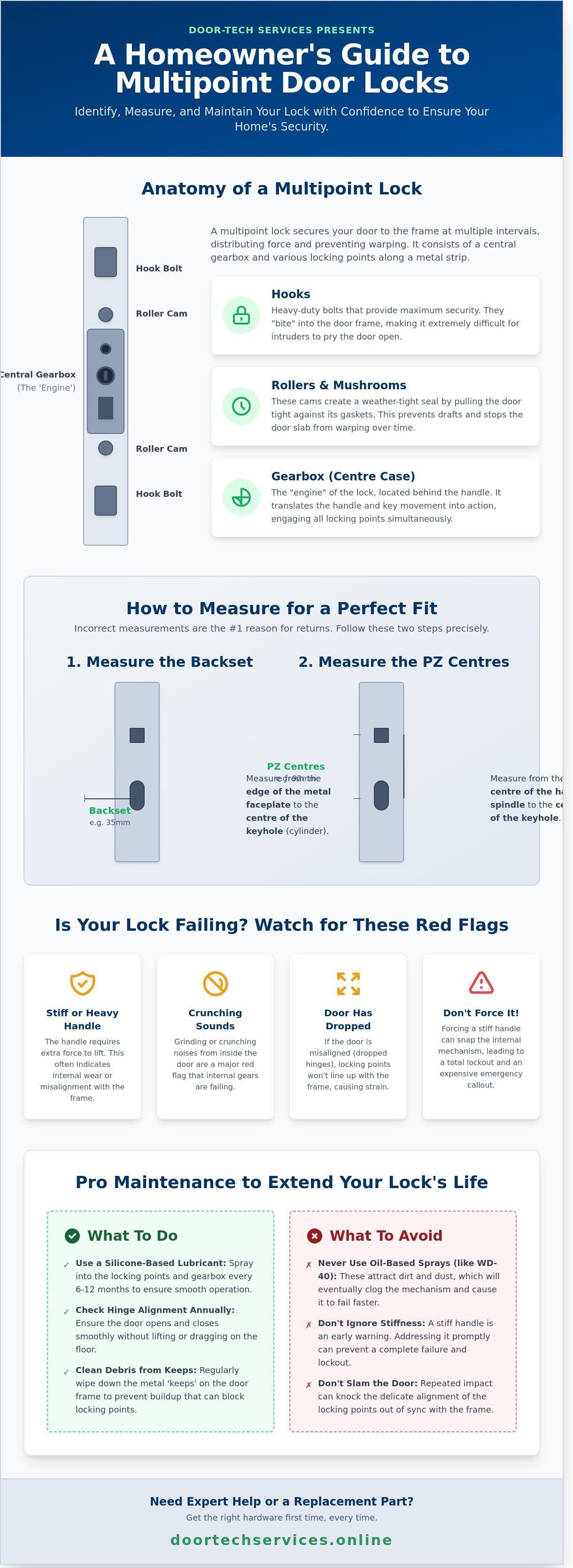
Multipoint Door Locks consist of a full-length metal strip that runs down the edge of your door. This system secures the door at multiple intervals rather than relying on a single central latch. Modern UK systems typically combine several locking mechanisms to provide both security and weatherproofing. These components are driven by a central gearbox, which translates the movement of your handle into the mechanical action of the locking points. You'll find that most domestic PVCu and composite doors utilize a faceplate width of either 16mm or 20mm. Measuring this width is your first step toward a successful replacement, as a 4mm difference will prevent the lock from sitting flush in the door channel.
The "locking points" are the specific parts that physically engage with the metal keeps fixed to your door frame. When you lift the handle, these components move simultaneously. This synchronized action distributes force across the entire height of the door, preventing the leaf from warping over time. If your door feels stiff or requires excessive force to lock, one of these points is likely misaligned with its corresponding keep.
Types of Locking Points and Their Specific Roles
Rollers: These cylindrical cams slide up and down. Their primary job involves pulling the door tightly against the rubber gasket to create a weather-tight seal.
Hooks: These are heavy-duty, curved bolts that "bite" into the frame keeps. They are specifically engineered to prevent intruders from using a crowbar to spread the frame away from the door.
Mushrooms and Pins: These intermediate security points feature a flared head. They provide additional grip within the keep, making it significantly harder for the door to be forced open during a jemmy attack.
The Difference Between Single and Twin or Split Spindle Gearboxes
The gearbox sits at the heart of the system. Single spindle gearboxes are the most common variety found in UK homes. This setup uses one solid spindle bar that passes through the handle and the lock. The handle height remains identical on both the inside and outside of the door. Operating the handle from either side will retract the latch and all locking points once the key has been turned.
Split spindle gearboxes uses two spindles. The handle height is identical on both the inside and outside of the door. Operating the handle from the inside will retract the latch and all locking points once the key has been turned, from the outside a key will be required to retract the latch.
Twin spindle gearboxes, often called split spindles, offer "night latch" functionality. You can identify these by looking for two separate spindle holes in the gearbox, usually spaced at 92mm and 62mm centres. This design ensures that the outside handle stays locked even when the door is closed, requiring a key for entry. If you're struggling to match your current hardware to a replacement, our technicians offer expert multipoint lock identification to ensure you get the right gearbox for your security needs.
Check your existing handle backplate; if the internal and external handles sit at different heights, you have a twin spindle system.
How to Measure and Identify Your Replacement Multipoint Lock
Precision is the foundation of home security. When you're dealing with Multipoint Door Locks, a "near enough" approach leads to mechanical failure. A discrepancy of just 2mm can prevent the locking points from engaging with the keeps in the frame, leaving your property vulnerable. You must achieve 100% accuracy before ordering a replacement part.
Always remove the lock from the door to get the most reliable measurements. Taking dimensions while the mechanism is still recessed in the door leaf often leads to errors due to the handle backplate or weather stripping. Lay the strip flat on a workbench or floor. This allows you to see the brand stamps and locking point positions clearly. If your lock is discontinued, which occurs in roughly 15% of repairs on doors over 20 years old, you'll likely need a universal repair kit. These kits feature serrated strips that you can cut to size to match your specific door height.
The Three Essential Measurements: Backset, Centres, and Faceplate
You need three specific figures to ensure the new gearbox and strip fit your door's existing preparation. First, measure the backset. This is the horizontal distance from the front of the metal faceplate to the centre of the keyhole. In the UK, 35mm is the standard for 70% of PVCu installations, though 45mm is common for composite & timber doors.
Next, calculate the centres, often called the PZ measurement. This is the vertical distance between the centre of the handle spindle and the centre of the circular part of the key cylinder. A 92mm PZ is the industry standard for most modern Multipoint Door Locks, but older Ferco or GU models may use a 70mm or 105mm configuration. Finally, check the faceplate width. A 16mm width is standard for PVCu doors, while 20mm is the typical requirement for timber or composite doors to provide extra stability in the wood grain.
Identifying the Brand and Model of Your Existing Lock
Look for a manufacturer logo stamped directly onto the faceplate or the side of the central gearbox. Common UK brands include Yale, ERA, GU, Fullex, and Winkhaus. Identifying the brand narrows down the search significantly because each manufacturer uses distinct latch and deadbolt positions.
Note the locking type: Document the sequence of locking points from top to bottom, such as Hook-Roller-Latch-Roller-Hook.
Measure the outer points: Record the distance between the two outermost locking points to ensure they align with your existing frame keeps.
Check the gearbox height: Standard gearboxes are usually 195mm to 220mm tall; verify this to ensure the new unit fits the internal cavity.
Don't ignore the overall length of the metal strip. Most full-length strips are 2200mm long but are designed to be cropped at the top and bottom during installation. If your lock features "offset" spindles or a twin-spindle gearbox, you'll need an exact match to keep your existing handles functional. Accuracy now saves hours of frustration later. Get the numbers right, and the installation will be a seamless process.
Enhancing Security and Longevity through Proper Maintenance
A high-quality multipoint door lock is a precision-engineered component. When you treat it with care, it can easily provide over 12 years of reliable service. Neglect is the primary cause of premature failure in these systems. Most homeowners only think about their locks when the handle becomes stiff or the key won't turn. By then, internal damage often already exists within the gearbox. Regular attention ensures your home remains secure and prevents the cost of an emergency call-out.
Choice of lubricant is critical for mechanical health. Use a dedicated silicone-based lubricant to keep the moving parts fluid and responsive. Avoid heavy grease or standard WD-40. These substances attract dust and grit; they eventually form an abrasive paste that grinds down the internal gears. Apply the silicone spray to the hooks, deadbolts, and the latch twice every year to ensure seamless operation.
Think of your door as a security chain. The Multipoint Door Locks mechanism acts as the heavy-duty body, but the euro cylinder is the critical link that controls it. If the cylinder is weak, the entire system is vulnerable. The relationship between the lock and the door frame keeps must also be perfect. If the door drops by even 2mm, the locking points won't align with the keeps, which forces the mechanism to work harder than intended.
Simple Steps to Organise a Maintenance Routine
Check for loose screws on the handle and the faceplate twice a year to prevent internal shifting.
Clear any stones, leaves, or debris from the bottom keeps to ensure the bolts can extend fully.
Verify that the door is correctly aligned by checking the gaps between the door leaf and the frame.
Lock binding occurs when the door is misaligned, forcing the hooks or bolts to scrape against the keeps and putting immense pressure on the internal gearbox. If you have to "lift" the handle with significant force, your lock is binding and requires immediate adjustment.
Upgrading Your Security with Anti-Snap Euro Cylinders
The Multipoint Door Locks on your property are operated entirely by the euro cylinder. Standard cylinders are often the weakest point of an entry door. To achieve maximum protection, you should choose 3-star Kitemarked cylinders. These are specifically tested to resist snapping, drilling, and picking. Investing in a certified cylinder ensures that the physical strength of your multipoint system isn't bypassed by a simple pair of pliers. Before you buy a replacement, you must know how to measure a euro cylinder to ensure it fits flush with your handle backplate. A cylinder that protrudes more than 3mm is a major security risk.
If your lock feels stiff or the handle is drooping, don't wait for a total failure. You can contact Door Tech Services for a professional alignment check today to restore your door's security.
Finding the Right Replacement Hardware with Door-Tech Services
Door-Tech Services operates as the UK specialist for hard-to-find door hardware. Most general DIY stores stock a limited range of universal products that rarely fit older or bespoke installations. We maintain an inventory of over 500 unique components to ensure you find an exact match for your home. Replacing a full locking strip can cost upwards of £120, but we often provide replacement gearboxes for under £45. This saves you 60% on material costs while restoring your door to full security. Our team understands that a broken lock is an emergency. We prioritise speed and technical accuracy to get your home secure again.
Specialist Inventory: We stock brands that big-box retailers don't carry, including obsolete models.
Cost-Effective Repairs: We sell individual gearboxes, so you don't have to buy the entire metal strip.
Expert Verification: Every part is vetted for trade-quality standards before it enters our warehouse.
Urgent Response: We offer rapid shipping options across the UK to resolve security breaches fast.
Why Precision is Vital for Replacement Success
Precision isn't just about a neat fit; it's about structural integrity. Forcing a generic lock into an existing cavity often requires DIY modifications that weaken the door frame. A door that's been heavily chiselled is 30% more likely to fail during a forced entry attempt. Our expert-vetted inventory ensures you receive a component that aligns perfectly with your existing keeps and handles. We provide fast UK delivery, often arriving within 24 hours, because security repairs cannot wait. Getting the right Multipoint Door Locks the first time prevents unnecessary damage to your PVCu or composite door.
Getting Expert Support for Your Security Project
Identifying the correct hardware is the most difficult part of the repair. We encourage you to take clear photos of your existing gearbox and send them to our technical team for identification. We identify 98% of locks from a single set of images, which removes the guesswork and prevents the frustration of ordering the wrong part. Every product in our range meets rigorous standards for cycle testing and weather resistance. We focus on long-term value, ensuring your hardware survives the British weather and thousands of operations. Don't settle for a temporary fix when you can install a permanent solution.
Ready to secure your home with professional-grade hardware? Browse our full range of Multipoint Door Locks to find your exact match today.
Restore Your Home Security with Precision Hardware
Your home security depends on the integrity of your locking mechanism. Identifying the specific configuration of hooks, rollers, and deadbolts is the first step toward a successful repair. Precise measurements prevent the frustration of a misaligned fit; they ensure your door remains a heavy-duty barrier. If your handle feels stiff or the mechanism grinds, don't ignore these warning signs. Replacing worn Multipoint Door Locks immediately restores the safety and functional restoration of your property.
Door Tech Services has delivered specialist UK-based expertise since 2007. We stock a comprehensive range of trade-quality hardware designed for durability and long-term value. With over 45 years of experience in the industry, we understand that reliability is your top priority. Our inventory features certified components that meet rigorous safety standards. You can find the exact match for your door through our streamlined online shop. Stop worrying about mechanical failures and invest in a solution that works perfectly the first time.
Take control of your home protection today and enjoy the peace of mind that comes with a fully functional, professional-grade lock.
Frequently Asked Questions
How do I know which multipoint lock I need for my door?
Identify the brand name stamped on the long metal faceplate and measure the backset and centres immediately. You must also count and identify the type of locking points, such as hooks, deadbolts, or rollers. There are over 500 variations of multipoint door locks in the UK market. Matching these exact dimensions ensures a seamless fit and restores your home's security without delay.
Can I just replace the gearbox instead of the whole multipoint strip?
Yes, you can replace just the central gearbox if the rest of the metal strip remains in good condition. This targeted repair typically costs between £40 and £85 for the component, which is roughly 50% cheaper than purchasing a full-length mechanism. We recommend this solution for common brands like GU or ERA where the gearbox is secured by 2 or 3 simple screws.
What is the difference between a 35mm and 45mm backset?
The backset is the precise distance from the front of the lock faceplate to the centre of the keyhole. A 35mm backset is the standard for 90% of PVCu doors, while 45mm is frequently found on timber or composite doors. Measuring this accurately to the nearest millimetre is vital. A 10mm discrepancy will prevent your handles and cylinder from aligning with the door's pre-drilled holes.
Why has my multipoint door lock stopped working suddenly?
Mechanical failure usually occurs because internal drive gears have snapped due to door misalignment. If you have to lift the handle with significant force, you are putting 5 times the intended pressure on the internal components. This stress leads to a total jam. A professional calibration of the door hinges often prevents this £150 to £300 replacement cost if caught early.
What are the most common brands of multipoint locks in the UK?
The UK market is dominated by manufacturers like ERA, GU, Fuhr, Winkhaus, and Yale. These brands account for approximately 85% of the multipoint door locks installed in modern residential properties over the last 20 years. Identifying the logo stamped on the metal faceplate helps us source the exact heavy-duty replacement required to secure your property today.
Is it possible to upgrade my existing multipoint lock to a more secure version?
You can upgrade to "hook and bolt" versions that meet PAS 24 security standards for enhanced protection against forced entry. Many older systems use simple rollers that provide weather sealing but lack robust security. Upgrading to a 3-star diamond-rated cylinder alongside your new lock provides a certified barrier that stops 99% of lock-snapping attempts instantly.
Do I need to replace the keeps on the door frame when I change the lock?
You only need to replace the keeps if you are changing the brand or the specific type of locking points on the strip. If you install an identical replacement, the existing keeps will align perfectly. However, if the old keeps show signs of metal fatigue or are misaligned by more than 2mm, replacing them ensures the new mechanism operates with precision and stays under guarantee.
How do I measure the "centres" on a multipoint lock?
Measure the distance from the centre of the handle spindle to the centre of the circular part of the keyhole. The most common measurement in the UK is 92mm, though older locks often use 70mm or 92/62mm twin-spindle configurations. Get this measurement right to ensure your door handles fit back onto the door without the need for drilling new holes or damaging the door leaf.



Comments